Showing posts with label Health. Show all posts

Tuesday, May 10, 2022

Analyzing the vaccination debate in social media data Pre- and Post-COVID-19 pandemic

In the past we have written about how vaccination is discussed on social media but such studies were often just focused on short study periods (i.e. a month). However, with the current COVID-19 pandemic we thought we would revisit the vaccination  debate and see if it has changed. So in a new paper with Qingqing Chen entitled "Analyzing the vaccination debate in social media data Pre- and Post-COVID-19 pandemic," we did just that. We explored approximately 11.7 million tweets posted between January 2015 to July 2021 and measured and mapped vaccine sentiments (Pro-vaccine, Anti-vaccine, and Neutral) across the US. Not to ruin the surprise of what we found but also to encourage you to read the paper we will not write about the results here. Only show the abstract of the paper, a few of the figures and a link to the paper itself.

Abstract

The COVID-19 virus has caused and continues to cause unprecedented impacts on the life trajectories of millions of people globally. Recently, to combat the transmission of the virus, vaccination campaigns around the world have become prevalent. However, while many see such campaigns as positive (e.g., protecting lives), others see them as negative (e.g., the side effects that are not fully understood scientifically), resulting in diverse sentiments towards vaccination campaigns. In addition, the diverse sentiments have seldom been systematically quantified let alone their dynamic changes over space and time. To shed light on this issue, we propose an approach to analyze vaccine sentiments in space and time by using supervised machine learning combined with word embedding techniques. Taking the United States as a test case, we utilize a Twitter dataset (approximately 11.7 million tweets) from January 2015 to July 2021 and measure and map vaccine sentiments (Pro-vaccine, Anti-vaccine, and Neutral) across the nation. In doing so, we can capture the heterogeneous public opinions within social media discussions regarding vaccination among states. Results show how positive sentiment in social media has a strong correlation with the actual vaccinated population. Furthermore, we introduce a simple ratio between Anti and Pro-vaccine as a proxy to quantify vaccine hesitancy and show how our results align with other traditional survey approaches. The proposed approach illustrates the potential to monitor the dynamics of vaccine opinion distribution online, which we hope, can be helpful to explain vaccination rates for the ongoing COVID-19 pandemic.

Keywords: COVID-19, Pandemic, Vaccination Sentiment Analysis, Time and Space, Social Media, United States.

Overview of our research pipeline.

Comparison between Twitter data and Google Trends. (a) Distribution of keywords search and tweets over time; (b) Correlation between Google Trends and Twitter data of keywords search; (c) Important news or announcements catched on Twitter activity (Note: period is the shaded area in (a)).

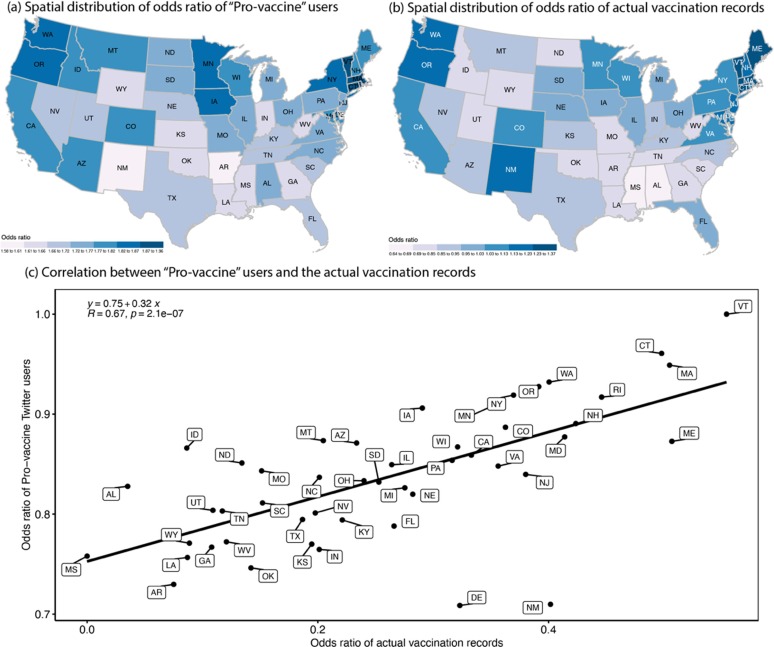
Correlation between Pro-vaccine users and actual vaccination records (a) Spatial distribution of odds ratio of Pro-vaccine users; (b) Spatial distribution of odds ratio of actual vaccination records; (c) Correlation between the Pro-vaccine users and the actual vaccination records.

Full Reference: 

Chen, Q. and Crooks, A.T. (2022), Analyzing the Vaccination Debate in Social Media Data Pre- and Post-COVID-19 Pandemic, International Journal of Applied Earth Observation and Geoinformation, 110: 102783.  Available at https://doi.org/10.1016/j.jag.2022.102783 (pdf)


Wednesday, September 04, 2019

Communities, Bots and Vaccinations

Following on from our work on bots and health discussions in relation to online social networks (OSNs), Xiaoyi Yuan, Ross Schuchard and myself have just published a paper entitled "Examining Emergent Communities and Detecting Social Bots within the Polarized Online Vaccination Debate in Twitter" in Social Media + Society. Within the paper we explore the communication patterns of vaccine discussions in Twitter. More specifically we ask three questions:
  1. Do vaccine discussions on Twitter show a highly clustered pattern in the sense that users tend to communicate more often with those who have same opinions towards vaccination than those who do not? 
  2. If the communication is highly clustered, to what extent do pro-vaccine users reach out to anti-vaccine users and vice versa? 
  3. How much do social bots, computer algorithms designed to mimic human behavior and interact with humans in an automated fashion, contribute to the conversation as previous research has shown that social bots can have certain impact on human communication in social media?
In order to answer these questions, we use a variety of machine learning techniques (e.g.  logistic regression, support vector machine (e.g. linear and non-linear kernel), k-nearest neighbors, nearest centroid, and Naïve Bayes) trained with labeled data (which is available at https://github.com/XiaoyiYuan/vaccination_online_discussion) to categorize each user’s vaccination stance. By exploring a combination of opinion groups and retweet networks we discovered that pro- and anti-vaccine users retweet predominantly from their own opinion group, while users with neutral opinions are distributed across communities. In addition, our bot analysis (using the  open-source DeBot detection platform) discovered that 1.45% of the corpus users were identified as likely bots and these produced 4.59% of all tweets within our data set. If you wish to find out more about our paper, below you can read the abstract along with seeing some figures including a sketch of our methodology, a selection of results and a link to the paper.

Abstract:
Many states in the United States allow a “belief exemption” for measles, mumps, and rubella (MMR) vaccines. People’s opinion on whether or not to take the vaccine can have direct consequences in public health. Social media has been one of the dominant communication channels for people to express their opinions of vaccination. Despite governmental organizations’ efforts of disseminating information of vaccination benefits, anti-vaccine sentiment is still gaining momentum. Studies have shown that bots on social media (i.e., social bots) can influence opinion trends by posting a substantial number of automated messages. The research presented here investigates the communication patterns of anti- and pro-vaccine users and the role of bots in Twitter by studying a retweet network related to MMR vaccine after the 2015 California Disneyland measles outbreak. We first classified the users into anti-vaccination, neutral to vaccination, and pro-vaccination groups using supervised machine learning. We discovered that pro- and anti-vaccine users retweet predominantly from their own opinion group. In addition, our bot analysis discovers that 1.45% of the corpus users were identified as likely bots which produced 4.59% of all tweets within our dataset. We further found that bots display hyper-social tendencies by initiating retweets at higher frequencies with users within the same opinion group. The article concludes that highly clustered anti-vaccine Twitter users make it difficult for health organizations to penetrate and counter opinionated information while social bots may be deepening this trend. We believe that these findings can be useful in developing strategies for health communication of vaccination.

Keywords: Anti-vaccine Movement, Twitter, Social Media, Opinion Classification, Bot Analysis


Full Reference:
Yuan, X.,  Schuchard, R.  and Crooks, A.T. (2019), Examining Emergent Communities and Detecting Social Bots within the Polarized Online Vaccination Debate in Twitter, Social Media + Society. https://doi.org/10.1177/2056305119865465 (pdf)

Wednesday, July 18, 2018

Online Vaccination Discussion and Communities in Twitter

Continuing on our work of exploring health related issues in social media, Xiaoyi Yuan and myself had a paper accepted at the 9th International Conference on Social Media and Society. In our paper entitled: "Examining Online Vaccination Discussion and Communities in Twitter"  we examined the communication patterns of anti-vaccine and pro-vaccine users on Twitter by studying the retweet network from 660,892 tweets related to the measles, mumps, and rubella (MMR) vaccine published by 269,623 users using supervised learning to identify clusters of users based on their opinions (i.e. a pro-vaccine, anti-vaccine, or neutral user). 

The overall methodology can be seen in Figure 1 and more details can be found in the paper. Our data was collected using the GeoSocial Gauge System, however, since tweets are short and their content diverse, the data corpus needed to be cleaned so that the tweets could then be converted to features (e.g., unigrams or bigrams). After which we were able to use such features for training a variety of classifiers (i.e., logistic regression, support vector machine (linear and non-linear kernel), k-nearest neighbors, nearest centroid, and Naïve Bayes) to identify opinion groups. After this, we moved from on from identifying each user’s opinion to construct a retweet network in order to understand how in-group and cross-group communicate in the committees detected via retweet network. By carrying out this analysis we discovered that pro- and anti-vaccine users retweet predominantly from their own opinion group, while users with neutral opinions are distributed across communities. Below you can read our abstract, see some results from our study and the full reference (and link) to the paper.


Figure1: Steps used in our study to unveil the communication patterns of pro-vaccine and anti-vaccine users on Twitter
 Abstract:
Many states in the US allow a “belief exemption” for measles, mumps, and rubella (MMR) vaccines. People’s opinion on whether or not to take the vaccine could have direct consequences in public health— once the vaccine refusal of a group within a population is higher than what herd immunity can tolerate, a disease can transmit fast causing large scale of disease outbreaks. Social media has been one of the dominant communication channels for people to express their opinions of vaccination. Despite governmental organizations’ effects of disseminating information of vaccination benefits, anti-vaccine sentiment is still gaining its momentum, especially on social media. This research investigates the communicative patterns of anti-vaccine and pro-vaccine users on Twitter by studying the retweet network from 660,892 tweets related to MMR vaccine published by 269,623 users after the 2015 California Disneyland measles outbreak. Using supervised learning, we classified the users into anti-vaccination, neutral to vaccination, and pro-vaccination groups. Using a combination of opinion groups and retweet network structural community detection, we discovered that pro- and anti-vaccine users retweet predominantly from their own opinion group, while users with neutral opinions are distributed across communities. For most cross-group communication, it was found that pro-vaccination users were retweeting anti-vaccination users than vice-versa. The paper concludes that anti-vaccine Twitter users are highly clustered and enclosed communities, and this makes it difficult for health organizations to penetrate and counter opinionated information. We believe that this finding may be useful in developing strategies for health communication of vaccination and overcome some the limits of current strategies.

Key Words: Anti-vaccine movement, Twitter, social media, opinion classification
Figure 2: Network visualizations of the four largest communities. A: is colored by the belonging to a specific structural community and; B: is colored by belonging to opinion groups

Figure 3: Distributions of opinion groups in the four largest structural community

Full Reference:
Yuan, X. and Crooks, A.T. (2018), Examining Online Vaccination Discussion and Communities in Twitter, Proceedings of the 9th International Conference on Social Media and Society, Copenhagen, Denmark, pp 197-206. (pdf)

Update: Our paper was selected as best paper at the conference.


Tuesday, January 09, 2018

New Paper: Cancer and Social Media

Continuing our work on geosocial analysis we recently had a paper entitled "Cancer and Social Media: A Comparison of Traffic about Breast Cancer, Prostate Cancer, and Other Reproductive Cancers on Twitter and Instagram" published in the Journal of Health Communication. In the paper we  present a comparative study of differences in messaging for women’s and men’s cancer campaigns on social media through three discrete approaches. 
  1. we directly compare the incident rates of women’s and men’s cancers in the United States to the corresponding levels of traffic that these cancers elicited during World Cancer Day across two social media platforms, Twitter and Instagram. 
  2. we examine social media activity for breast cancer versus prostate cancer on both Twitter and Instagram during the dedicated month-long campaigns (October and November, respectively). 
  3. we compare the top terms associated with each campaign on these two social media platforms to discover whether there are differences in the terms associated with these online discussions.
Below you can read the abstract to our paper, see some of our results and at the bottom of the post have the full citation and link to the paper.

Abstract: 
Social media are often heralded as offering cancer campaigns new opportunities to reach the public. However, these campaigns may not be equally successful, depending on the nature of the campaign itself, the type of cancer being addressed, and the social media platform being examined. This study is the first to compare social media activity on Twitter and Instagram across three time periods: #WorldCancerDay in February, the annual month-long campaigns of National Breast Cancer Awareness Month (NBCAM) in October and Movember in November, and during the full year outside of these campaigns. Our results suggest that women’s reproductive cancers – especially breast cancer – tend to outperform men’s reproductive cancer – especially prostate cancer – across campaigns and social media platforms. Twitter overall generates substantially more activity than Instagram for both cancer campaigns, suggesting Instagram may be an untapped resource. However, the messaging for both campaigns tends to focus on awareness and support rather than on concrete actions and behaviors. We suggest health communication efforts need to focus on effective messaging and building engaged communities for cancer communication across social media platforms.


A comparison of percentages of cancer cases (green bars) and references to corresponding cancers in Twitter (blue bar) and Instagram (orange bar) during World Cancer Day 2016.

 References to breast cancer (green line), prostate cancer (orange line), and Movember (blue line) over the full year 2015 in Instagram.

Full Reference: 

Vraga, E., Stefanidis, A., Lamprianidis, G., Croitoru, A., Crooks, A.T. Delamater, P.L., Pfoser, D., Radzikowski, J. and Jacobsen, K.H. (2018), Cancer and Social Media: A Comparison of Traffic about Breast Cancer, Prostate Cancer, and Other Reproductive Cancers on Twitter and Instagram, Journal of Health Communication. 3(2), 181-189. (pdf)

Friday, November 17, 2017

New Paper: Social Media and Cancer Campaigns

Continuing our work on geosocial analysis we recently had a paper entitled "Social Media Engagement with Cancer Awareness Campaigns Declined During the 2016 U.S. Presidential Election" published in  World Medical and Health Policy. In the paper we show through the analysis of Twitter and Google Trends, how public engagement with breast cancer and prostate cancer awareness months between 2015 and 2016 changed. Specifically we found that attention to breast cancer and prostate cancer declined in 2016 (during the U.S. presidential election), when compared to 2015. Based on our finding we suggest that future cancer education campaigns—and campaigns for other health issues and policies—would benefit from monitoring the broader issues producing social media engagement, and adjusting their timing or communication strategies to ensure that public engagement with their key messages remains strong even in a crowded social media marketplace. Below you can read the abstract to our paper, see some of our key findings along with the full citation to the paper.

Abstract:
Cancer awareness campaigns compete with other health and social issues for public attention. We examined whether public engagement with breast cancer and prostate cancer declined in 2016 during the U.S. presidential election compared to 2015 on Twitter and Google Trends. We found that attention to breast cancer and prostate cancer declined in 2016 before the election as compared to 2015 in Twitter posts and Google searches. The findings suggest that cancer information seeking behavior, passive exposure to health communication, and active participation in social media about cancer all decreased during the peak weeks of the 2016 election season. Future health promotion initiatives and information dissemination efforts will benefit from monitoring the major issues garnering social media attention and then adjusting their timing or communication strategies to ensure that public engagement with their key policy messages remains strong when emerging news stories capture public interest.

Keywords: Twitter; breast cancer; prostate cancer

Twitter Traffic about Breast Cancer (a) and Prostate Cancer (b) in the Period October 2015–November 2016, and Comparison of October and November Traffic in 2015 and 2016 for Breast Cancer (c) and Prostate Cancer (d). All 2015 Data are Shown in Red and All 2016 Data are Shown in Blue.


Full Reference:
Vraga, E. K., Radzikowski, J., Stefanidis, A., Croitoru, A., Crooks, A.T., Delamater, P., Pfoser, D. and Jacobsen, K. H. (2017). Social Media Engagement with Cancer Awareness Campaigns Declined During the 2016 U.S. Presidential Election. World Medical and Health Policy, 9(4): 456–465. (pdf)

Thursday, April 20, 2017

Zika in Twitter: Health Narratives


In the paper we explored how health narratives and event storylines pertaining to the recent Zika outbreak emerged in social media and how it related to news stories and actual events.

Specifically we combined actors (e.g. twitter uses), locations (e.g. where the tweets originated) and concepts (e.g. emerging narratives such as pregnancy) to gain insights on the mechanisms that drive participation, contributions, and interactions on social media  during a disease outbreak. Below you can read a summary of our paper along with some of the figures which highlight our methodology and findings.  

An overview of the Twitter narrative analysis approach, starting with data collection, and proceeding with preprocessing and data analysis to identify narrative events, which can be used to build an event storyline.


Abstract:
 
Background: The recent Zika outbreak witnessed the disease evolving from a regional health concern to a global epidemic. During this process, different communities across the globe became involved in Twitter, discussing the disease and key issues associated with it. This paper presents a study of this discussion in Twitter, at the nexus of location, actors, and concepts.
Objective: Our objective in this study was to demonstrate the significance of 3 types of events: location related, actor related, and concept- related for understanding how a public health emergency of international concern plays out in social media, and Twitter in particular. Accordingly, the study contributes to research efforts toward gaining insights on the mechanisms that drive participation, contributions, and interaction in this social media platform during a disease outbreak. 
Methods: We collected 6,249,626 tweets referring to the Zika outbreak over a period of 12 weeks early in the outbreak (December 2015 through March 2016). We analyzed this data corpus in terms of its geographical footprint, the actors participating in the discourse, and emerging concepts associated with the issue. Data were visualized and evaluated with spatiotemporal and network analysis tools to capture the evolution of interest on the topic and to reveal connections between locations, actors, and concepts in the form of interaction networks. 
Results: The spatiotemporal analysis of Twitter contributions reflects the spread of interest in Zika from its original hotspot in South America to North America and then across the globe. The Centers for Disease Control and World Health Organization had a prominent presence in social media discussions. Tweets about pregnancy and abortion increased as more information about this emerging infectious disease was presented to the public and public figures became involved in this. 
Conclusions: The results of this study show the utility of analyzing temporal variations in the analytic triad of locations, actors, and concepts. This contributes to advancing our understanding of social media discourse during a public health emergency of international concern.

Keywords: Zika Virus; Social Media; Twitter Messaging; Geographic Information Systems.

Spatiotemporal participation patterns and identifiable clusters over 4 of our twelve week study. The top left panel shows the data during the first week, and time progresses from left to right and from top to bottom towards .

Subsets of the full retweet network pertaining to the WHO (left) and CDC (right), and clusters identified within them. Magenta clusters are centered upon health entities, green upon news organizations, orange upon political entities.

Visualizing a narrative storyline across locations (blue), actors (red), and concepts (green).

Full Reference:
Stefanidis, A., Vraga, E., Lamprianidis, G., Radzikowski, J., Delamater, P.L., Jacobsen, K.H., Pfoser, D., Croitoru, A. and Crooks, A.T. (2017). “Zika in Twitter: Temporal Variations of Locations, Actors, and Concepts”, JMIR Public Health and Surveillance, 3 (2): e22. (pdf)

As normal, any feedback or comments are most welcome. 

Tuesday, March 01, 2016

Lessons from the Ebola Outbreak: Action Items for Emerging Infectious Disease Preparedness and Response


In the paper we discuss the recent Ebola outbreak in West Africa, which was the longest, largest and most widespread of its type up to now. Now as it wanes, we argue in the paper that it is time for the international scientific community to  reflect on how to improve the detection of and coordinated response to future epidemics. Our interdisciplinary team (17 authors! from a varity of Deparments and Colleges from Mason including Global and Community Health, Environmental Science and Policy, Biomedical Research, Systems Biology, Computational Social Science, Geography and GeoInformation Science, Communication and Mathematical Sciences) identified key lessons learned from the Ebola outbreak that can be clustered into three areas: 1) environmental conditions related to early warning systems, 2) host characteristics related to public health, and 3) agent issues that can be addressed through the laboratory sciences". Below is the abstract for the paper:

As the Ebola outbreak in West Africa wanes, it is time for the international scientific community to  reflect on how to improve the detection of and coordinated response to future epidemics. Our interdisciplinary team identified key lessons learned from the Ebola outbreak that can be clustered into three areas: environmental conditions related to early warning systems, host characteristics related to public health, and agent issues that can be addressed through the laboratory sciences. In particular, we need to increase zoonotic surveillance activities, implement more effective ecological health interventions, expand prediction modeling,  support medical and public health systems in order to improve local and international responses to epidemics,  improve risk communication, better understand the role of social media in outbreak awareness and response, produce better diagnostic tools, create better therapeutic medications, and design better vaccines. This list  highlights research priorities and policy actions the global community can take now to be better prepared for  future emerging infectious disease outbreaks that threaten global public health and security.

Keywords: Ebola infection, emerging infectious diseases, epidemics, surveillance, one health, public health.


Full reference:
Jacobsen, K.H., Aguirre, A.A., Bailey, C.L., Baranova, A.V., Crooks, A.T., Croitoru, A., Delamater, P.L., Gupta, J., Kehn-Hall, K., Narayanan, A., Pierobon, M., Rowan K.E., Schwebach, J.R., Seshaiyer, P., Sklarew, D.M., Stefanidis, A. and Agouris, P. (2016), Lessons from the Ebola Outbreak: Action Items for Emerging Infectious Disease Preparedness and Response, EcoHealth, 13(1): 200-212 DOI: 10.1007/s10393-016-1100-5 (pdf)