Showing posts with label Urban Analytics. Show all posts

Saturday, July 05, 2025

New Editorial: Generative AI and Urban Modeling

In the current issue of Environment and Planning B, we (Boyu WangNa Jiang and myself) have a new editorial entitled "Generative AI and Urban Modeling". The premise of this editorial is that Generative AI (GenAI) is impacting all aspects of our daily lives and as such has we were wondering how will it impact urban modeling? 

For example, in the editorial we discuss how  GenAI could speed up the overall urban modeling process. To demonstrate this we show how ChatGPT (and its built-in coding interface Canvas) can take published papers and build agent-based models from them (one being of an abstract space and another being spatially explicit). 

However, while model building is time consuming task, another challenge modelers face is how to incorporate decision making within them. To this end we also discuss how large language models (LLMs) have the potential to help with  agent-decision making in the form of generating  agent-personas or scheduling agent activities. 

We conclude the editorial with a series of questions: how will GenAI impact urban modeling? Will it open up the field to more people without the need for strong coding skills? Will we see growth in using LLMs for generating behavior? Will GenAI lead to a new generation of modeling toolkits? While these are only a short list of questions, they also raise concerns that relate back to some of the more thorny issues of urban modeling, that of verification and validation. 

If this sounds of interest you can read the full editorial here

Full Referece: 

Crooks, A.T., Jiang, N. and Wang, B. (2025), Generative AI and Urban Modeling, Environment and Planning B, 52(6), 1277-1281. (pdf)

Monday, June 30, 2025

CUPUM 2025

I have just gotten back from attending the 19th International Conference on Computational Urban Planning and Urban Management (CUPUM) in London and thought I would  share the two papers we presented at the conference. 

The first paper was with Qingqing Chen and Linda See and was entitled "Using New Sources of Data for Urban Climate Modeling Generated through MLLMs on Street View Imagery. "As the title might suggest, this paper was about how one can leverage multi-modal large language models (MLLMs) to extract information on building height, age and function from street level photographs. We demonstrate this using street view images from Mapillary and than ask ChatGPT to estimate the building height, age and function and compare the results to authoritative data sources. If this sounds of interest, below you can see the abstract to the paper, some if the figures (i.e., the work flow and prompts) while the results can be seen in the attached paper (see the link below).

Abstract:

Urban climate and energy balance models require data on the form and function of buildings, but high resolution spatially explicit data sets are often lacking. Here we demonstrate how multi-modal large language models (MLLMs) can be used to extract information on building height, age and function from street level photographs for New York City. A workflow is presented that illustrates the approach, with initial results indicating that the building function can be identified with good accuracy while moderate accuracies were obtained for building heights and age. Suggestions for how to improve these accuracies are also provided. 

KEYWORDS: Buildings, ChatGPT, Multi-modal Large Language Models (MLLMs), Mapillary, Street View Images (SVI).

An overview of research workflow.

The detailed description of multi-step prompting and an example of extracted building attributes information.

Full Reference:

Chen, Q., See, L. and Crooks, A.T. (2025), Using New Sources of Data for Urban Climate Modeling Generated through MLLMs on Street View Imagery. In Cramer-Greenbaum, S., Dennett, A., and Zhong, C (eds.), Proceedings of the 19th International Conference on Computational Urban Planning and Urban Management (CUPUM), London, UK. (pdf)


We then moved back to agent-based modeling with a paper with entitled "Enhancing Spatial Reasoning and Behavior in Urban ABMs with Large-Language Models and Geospatial Foundation Models" which brought back together Nick Malleson, Alison Heppenstall, Ed Manley and myself. In this paper we discuss the potential role of LLMs and geospatial foundation models in the context of agent-based modeling. If this sounds of interest, below you can read the abstract to the paper and find a link to it at the bottom of the post. Nick has also shared the slides of this presentation here

Abstract: 
Modeling human behavior continues to be a significant challenge for the field of agent-based modeling, and one that prohibits the development of comprehensive empirical ABMs for urban applications, such as Urban Digital Twins. However, two recent methodological advances offer the potential to transform empirical agent-based models.

Early evidence suggests that large-language models (LLMs) can be used to represent a wide range of human behaviors, with models responding in realistic ways to given prompts. Indeed there is already a flurry of activity that focusses on implementing LLM-backed agents -- i.e. agents who are controlled by LLMs. At the same time, the concept of the foundation model is also being applied in domains beyond text analysis. Of particular interest are geospatial foundation models that automatically encode spatial data in such a way as to associate different spatial objects in numerous and nuanced ways that have otherwise alluded manual classification schemes. Taken together, these two technologies offer considerable potential for a new generation of agent-based models that contain agents who can behave in response to spatial and social prompts in a way that is realistic and has so far proven impossible to replicate using manually-programmed behavioral rules.

This paper presents a discussion of the state of the art in both LLMs and geospatial foundation models in the context of their potential role in agent-based modelling. It discusses the transformational potential of these technologies and outlines the critical questions that need to be addressed before they can be used to create robust, reliable and trustworthy models for empirical policy applications that support decision-making.

KEYWORDS: Agent-based Modeling; Large language model; Geospatial foundation model; Urban Modeling.

Full Reference:

Malleson, N., Crooks, A.T., Heppenstall, A. and Manley, E. (2025), Enhancing Spatial Reasoning and Behavior in Urban ABMs with Large-Language Models and Geospatial Foundation Models. In Cramer-Greenbaum, S., Dennett, A., and Zhong, C (eds.), Proceedings of the 19th International Conference on Computational Urban Planning and Urban Management (CUPUM), London, UK. (pdf)

Saturday, June 21, 2025

Talks: ABM, AI and other Thoughts

This is a slightly different post to normal, in the sense its not really about papers but my take on agent-based modeling, urban analytics and the growth of Artificial Intelligence impacting both. 

First up, while I was in Santa Fe last October for the 2024 International Conference of the Computational Social Science Society of the Americas  I was interviewed by John Cordier from Epistemix for their Flux Podcast which resulted in this "From Micro-Behaviors to Macro-Patterns: Exploring Agent-Based Models with Andrew Crooks. Rather than me trying to sum it up I will just quote from the podcast episode 

"In this episode of The Flux, host John Cordier sits down with Andrew Crooks ..... They dive into the world of agent-based modeling (ABM) - what it is, why it matters, and how it helps us simulate and better understand human behavior in complex systems. From simulating traffic jams to modeling social influence on vaccine uptake, Andrew shares how data, geography, and synthetic populations are revolutionizing our ability to forecast and inform decisions. They also explore the growing role of AI tools in democratizing modeling, the evolution of computational capabilities, and even ask: what if we had run a simulation before Brexit?"

If this sounds of interest, you can listen to the full podcast here


Next up, I was asked to give a talk back in late May to give a seminar talk at the Department of Geography and Spatial Sciences (GSS) at the University at Delaware hosted by Yao Hu. The title of the talk was "Monitoring and Analyzing Cities through the Lens of Urban Analytics" In this talk I reflect what urban analytics means to me and how the field is changing. If this sounds of interest, below you can read the abstract to my talk and also see the recording. However, before ending this I would really like to thank Yao for hosting me, and the others from the GSS and the universty at large for making it a great visit and being an engaged audience. 


Abstract: 

For the first time in human history, more people are living in cities than rural areas and this trend is only expected to grow in the coming decades. This growth will place unprecedented challenges on cites with respect to sustainable development especially in light of climate change and increasing populations. One way to explore and understand cities is through the lens of urban analytics, a set of methods that allow us to monitor, analyze and model urban areas. This talk will explore how urban analytics has changed over time and showcase how our understanding of cities has benefited from it. I will showcase how new sources of data can be used to monitor and analyze cities and how in turn these can be integrated into models to explore various aspects of city life from pedestrian movement to urban growth. The talk will conclude with a discussion and demonstration of how artificial intelligence can be integrated into the urban analytics toolbox and what opportunities and challenges it poses.


Also in late May, Alison Heppenstall, and myself were interviewed by Dr. Andy Collins discussing as part of the Computational Social Science Society of the Americas (CSSSA) webinar series on Agent-based modeling and simulation (ABMS). To quote from CSSSA, the purpose of these webinars is that: 

"Agent-based modeling and simulation (ABMS) has been applied far and wide to better understand our world. Each new application domain brings with it existing cultures of the domain's experts, including expectations and requirements. As such, it is foolhardy to expect agent-based modeling to be standardized across all domains. As practitioners, there is a desire to understand how these domain cultures differ, how they use agent-based modeling, and what the future of agent-based modeling is within those domains. To start to grapple with these grand questions, for the ABMS community, we are proposing to run a series of interviews with experts from different domains to try to map the world of agent-based modeling."

Readers, might not be surprised but we were asked to discuss ABM in the context of geography. So if you want to hear us discuss ABM and geography, you can see the talk below. It should also be noted the CSSSA has a whole host of other webinars on their YouTube Channel


Finally, at the start of May, I was invited to give one of the keynotes at the Inaugural AI and Cities: An International Forum for Innovation and Collaboration hosted by University of Florida entitled "Artificial intelligence and Urban Analytics: Opportunities and Challenges."  This talk is slightly different from the others as the focus was more on AI, so if you are wondering what my take on AI is (or my current research), you can read the abstract to the talk below and also find a link to the recording of it. 

Abstract: Urban areas now provide homes for more people than ever before, and with more and more people living in cities achieving sustainable cities is crucial for the betterment of all. Coinciding with the growth of the world’s population is the growth of artificial intelligence (AI) is which is becoming pervasive in all aspects of our daily lives. In this talk I will discuss how AI is offering us new opportunities when it come studying cities, specifically, through the lens of urban analytics. Urban analytics can be broadly defined a set of methods to explore, understand and predict the properties of cities. Through a series of examples, I will highlight how AI especially through the use of multimodal large language models (LLMs) is offering accessible methods for geographic information extraction and modeling of cities. I will showcase how AI can improve the granularity of urban data collection while at the same time provides more advanced GIS tools to practitioners in a more accessible and user-friendly way. However, AI alone is not the panacea when it comes to archiving urban sustainability and many challenges exist and the talk with conclude with these.

If the abstract sounds interesting click here to watch the talk.  Also the other keynotes talks are also available online here

Monday, March 10, 2025

New Editorial: Cities and disasters: What can urban analytics do?

Image generated my Copilot with the promt "Cities and disasters: What can urban analytics do? Include natural disaster elements"
In the past I have blogged about disasters, but mainly from a social media or agent-based modeling perspective. However, after the devastating wildfires that impacted parts of Los Angeles County earlier this year led me to wonder how resilient are cities to such events? Or more generally, what role could urban analytics play on the various stages of disaster management (i.e., preparation, response, recovery, and mitigation), or how can data, models, and methods at the disposal of researchers be leveraged to better prepare us for future disasters and be linked to policy?

If these questions sound of interest, I encourage you to go and read  a short editorial that I recently published in Environment and Planning B entitled "Cities and Disasters: What can Urban Analytics Do?"

Full referece
Crooks, A.T. (2024), Cities and Disasters: What can Urban Analytics Do?, Environment and Planning B, 52(3): 523-526. (pdf)

Wednesday, June 28, 2023

Editorial: Urban analytical approaches to combating the Covid-19 pandemic

While there has been a lot written about COVID-19 Angela  Yao, Bin Jiang, Jukka Krisp, Xintao Liu, and Haosheng Huang and myself have just recently wrapped up a special issue in Environment and Planning B and how it can be studied through the lens of urban analytics.  After a call for papers for the special issue, we published 10 papers that cover a wide spectrum of analytical methods have been used to study the pandemic. These ranged from how policies impacted pedestrian patterns to how data could on the disease could be visualized along with many things in between. Below you can see papers:

Accompanying these papers is an editorial entitled "An overview of urban analytical approaches to combating the Covid-19 pandemic," In this editorial we situate these papers in the larger literature of urban analytics and Covid-19. Also in the editorial, we explore what can be learned from the current research on Covid-19 and finally we identify gaps and future research opportunities for urban analytics in combating epidemic outbreaks.

A framework of the Covid-19 pandemic dynamics in urban systems.


Covid-19 research themes and topics through the lens of geography and urban analytics.

Full Reference:

Yao, X.A, Crooks, A.T., Jiang, B., Krisp, J., Liu, X. and Huang, H. (2023), An overview of urban analytical approaches to combating the Covid-19 pandemic, Environment and Planning B, 50 (5), pp. 1133–1143. (pdf)


Wednesday, March 22, 2023

AAG 2023 Presentations

At this years Association of American Geographers (AAG) Annual Meeting we have a number of presentations ranging from how one can leverage newspaper articles to study cities over time, to that of how people may chose to become vaccinated. These presentations build on the great work of students and postdocs here at the University at Buffalo and link to our interests in urban analytics, machine learning and agent-based modeling. Below we just give a glimpse at these topics (along with their abstracts) and if you are interested in finding out more please reach out to us.

First up is a presentation with Qingqing Chen and Boyu Wang entitled "Community resilience to wildfires: A network analysis approach utilizing human mobility data."  In this presentation we explore how we can quantify a communities resilience to wildfires utilizing human mobility through network analysis methods. 

Abstract 

Natural disasters, such as earthquakes, floods, and wildfires, have been a long-standing concern to societies at large. With growing attention being paid to sustainable and resilient communities, such concern has been brought to the forefront of resilience studies. However, the definition of disaster resilience is intricate and can vary across the diverse disciplines that study them (e.g., geography, sociology and political science), making its definition and quantification elusive. Moreover, the vast majority of studies often focus on the immediate response to an event, not the long-term recovery of the area impacted by disasters. Thus to date investigating the resilience of an area or a society over a prolonged period of time has remained largely unexplored. To overcome these issues, we propose a novel approach from a social perspective utilizing network analysis and concepts from disaster science (e.g., the resilience triangle) to quantify the long-term impacts of wildfires, especially on collective human behavior. Taking the Camp and Mendocino Complex wildfires - the most deadly and the largest complex wildfires in California to date, respectively - as case studies, we capture the features of resilience, such as robustness and vulnerability, of communities based on human mobility data from 2018 to 2020. The results show that demographic and socioeconomic characteristics alone only partially capture community resilience, however, by leveraging human mobility data and network analysis techniques, we can enhance our understanding of resilience over space and time, which can provide a new lens to study natural disasters and their long-term impacts on society.

Keywords: Community Resilience, Natural Disasters, Wildfires, Social Network Analysis, Human Mobility, Space and Time.

Full Reference

Chen, Q., Wang, B. and Crooks, A.T. (2023), Community Resilience to Wildfires: A Network Analysis Approach Utilizing Human Mobility Data, The Association of American Geographers (AAG) Annual Meeting, 23rd –27th March, Denver, CO. (pdf)

Next up, moving from mobility to textural data, specifically that of newspapers Na (Richard) Jiang and myself have a presentation entitled "Leveraging Newspapers to Understand Urban Issues: A Longitudinal Analysis of Urban Shrinkage in Detroit". In this work we explore how can leverage Bertopic (a topic modeling technique) on newspaper articles spanning the years 1975 to 2021 to explore urban shrinkage in Detroit. 


Abstract 

Today we are awash with data especially when it comes to studying cities from a diverse data ecosystem ranging from demographic to that of remotely sensed imagery and social media. This has led to the growth of geographical data science and urban analytics providing new ways to conduct quantitative research within cities. One area that has seen significant growth is that of using natural language processing techniques on text data from social media to explore various issues relating to urban morphology. However, social media only provides limited insights when dealing with longer-term urban phenomena, such as the growth and shrinkage of cities. This relates to the fact that social media is a relatively recent phenomenon compared to more longer-term urban problems that take decades to emerge. With respect to the longer-term coverage, newspapers which are increasingly becoming digitized provide the possibility to overcome the limitations of social media and provide insights over a timeframe that social media does not. To demonstrate the utilization of newspapers within urban analytics and to study longer-term urban issues, we present an advanced topic modeling technique (i.e., Bertopic) on a large number of newspaper articles spanning the years 1975 to 2021 to explore urban shrinkage in Detroit. Our topic modeling results reveal the insights related to Detroit's shrinkage can be linked to the side effects of economic recessions on Detroit's automobile industry, local employment status, and the housing market. As such, this work demonstrates the potential of utilizing newspaper articles to study long-term issues

Keywords: Natural Language Processing, Topic Modeling, Newspapers, Text Data, Urban Shrinkage, Urban Analytics. 

 Full Reference

Jiang, N., and Crooks A.T. (2023), Leveraging Newspapers to Understand Urban Issues: A Longitudinal Analysis of Urban Shrinkage in Detroit, The Association of American Geographers (AAG) Annual Meeting, 23rd –27th March, Denver, CO. (pdf)

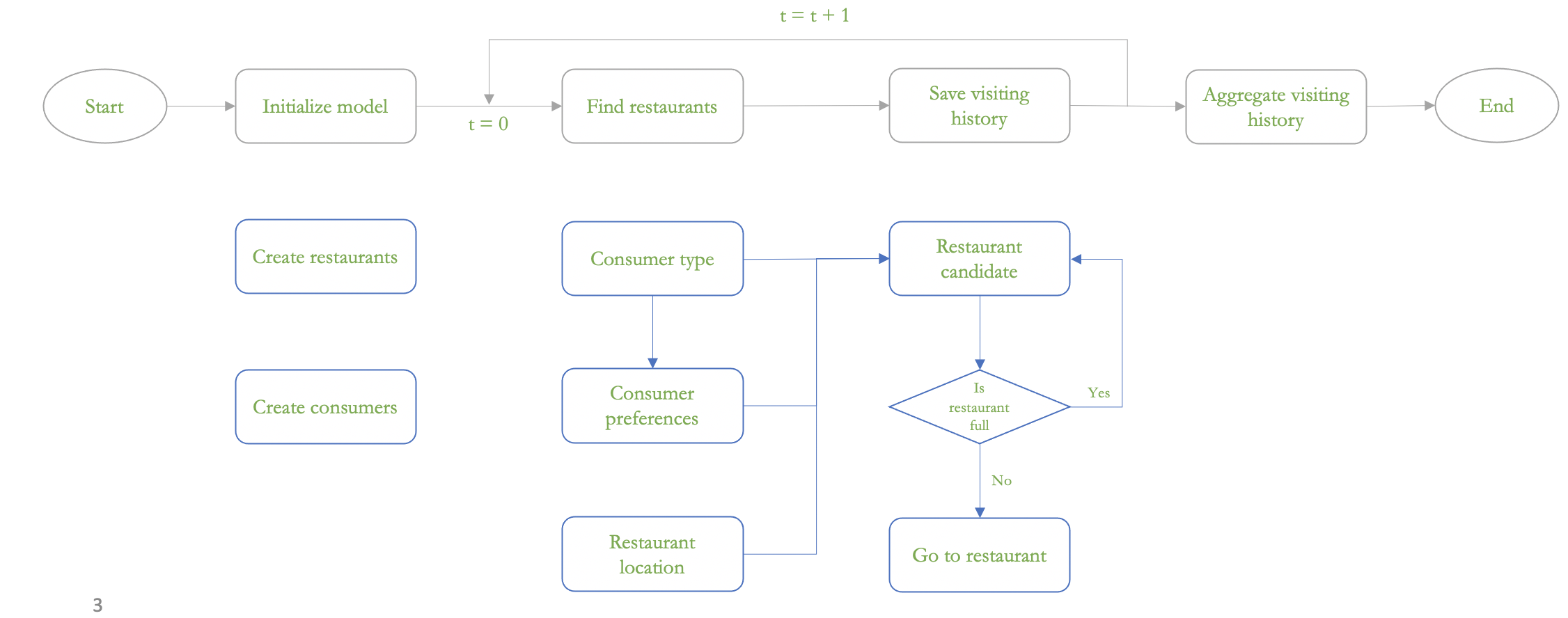
Switching gears slightly, we have another presentation that leverages text data, in this case Yelp reviews to help inform decision making within an agent-based model. This presentation with Boyu Wang is entitled "Do people care about others' opinions of places? Utilizing crowdsourced data and deep learning to model peoples’ review patterns."  We use a geospatial artificial intelligence (GeoAI) technique called aspect-based sentiment analysis to extract and categorize reviewers' opinion aspects on places within urban areas and then use this information to inform an agent-based model of peoples choices to which restaurants to go to.


Abstract  

People's opinions are one of the defining factors that turn spaces into meaningful places. While these opinions are subject to individual differences, they can also be influenced by the opinions from others. Online platforms such as Yelp allow users to publish their reviews on businesses. To understand reviewers' opinion formation processes and the emergent patterns of published opinions, we utilize geospatial artificial intelligence (GeoAI) techniques especially that of aspect-based sentiment analysis methods (a deep learning approach) on a geographically explicit Yelp dataset to extract and categorize reviewers' opinion aspects on places within urban areas. Such data is then used as a basis to inform an agent-based model, where reviewers' (i.e., agents') opinions are characterized by opinion dynamics. The parameters of these models are calibrated using extracted opinion aspects from the Yelp dataset. Such a method moves opinion dynamics models away from theoretical concepts to a more data-driven approach, with a specific emphasis being made on place. Focusing on 10 US metropolitan areas which are spread out across the country, we examine the calibrated influence coefficients for each opinion aspect category (e.g., location, experience, service), to compare reviewers' opinion formation processes across different categories. The results show the emergent patterns of reviewers' opinions and the influence of these opinions on others. As such this work demonstrates how using deep learning techniques on geospatial data can help advance our understanding of place and cities more generally.

Keywords: Agent-Based Modeling, Crowdsourcing, Deep Learning, GeoAI, Opinion Dynamics, Urban Analytics

Full Reference

Wang, B. and Crooks, A.T. (2023), Do People Care About Others' Opinions of Places? Utilizing Crowdsourced Data and Deep Learning to Model Peoples’ Review Patterns, The Association of American Geographers (AAG) Annual Meeting, 23rd –27th March, Denver, CO. (pdf)
Following with the agent-based modeling theme, our final presentation with Fuzhen Yin and Li Yin is entitled "How Information Propagation in Physical, Relational and Cyber Spaces Affects Covid-19 Vaccine Uptake: Evidence from Rural Areas." In this work we explore how people may or not be influenced by others (in physical, relational and cyber spaces) with respect to vaccination uptake.


Abstract 
With the advent of information and communication technologies, human dynamics studied in a purely physical space increasingly shift to a cyber and relational context. While researchers increasingly recognize the shift and call for attention to the multi-dimensionality of human dynamics (e.g., Splatial framework). Rarely have studies investigated how the information propagated in hybrid spaces affects people’s decision-making process, such as Covid-19 vaccine uptake. Meanwhile, compared to the urban population, the rural population faces greater digital barriers and has been further left out in human dynamics research. To fill this gap, our study investigates Covid-19 vaccine uptake in a rural county (i.e., Chautauqua) in New York State through agent-based modeling. We first generated a synthetic population to match the demographic characteristics of the census data. Then we created home, work, school, and social media networks to represent hybrid spaces. We defined the opinion dynamics of agents based on the social influence network theory. Next, we calibrated and validated our agent-based model based on real-world vaccine update records. Our research helps to elucidate the information propagation mechanism in hybrid spaces and clarify the decision-making process in the digital age. Furthermore, our method can also shed light on how to overcome data limitations for under-represented populations such as those who live in rural areas.

Keywords: Agent-based modeling, Covid-19, Vaccination, Opinion dynamics, Urban informatics, Rural geography

Full Reference 
Yin, F., Crooks, A.T. and Yin, L. (2023), How Information Propagation in Physical, Relational and Cyber Spaces Affects Covid-19 Vaccine Uptake: Evidence from Rural County, The Association of American Geographers (AAG) Annual Meeting, 23rd –27th March, Denver, CO. (pdf)

Tuesday, January 14, 2020

New Paper: Insights into Human-wildlife Interactions in Cities from Bird Sightings Recorded Online

In the past we have explored how social media can be used to delineate earthquakes, locate wildfires or be used to understand urban morphology. However, recently we have also started to explore how social media and crowdsourced data can be utilized to to study socio-environmental systems. Keeping with this them, Bianca Lopez, Emily Minor, and myself have recently had a paper published in Landscape and Urban Planning entitled "Insights into Human-wildlife Interactions in Cities from Bird Sightings Recorded Online."  

In the paper we explore where do people observe birds, using the city of Chicago as our case study. By utilizing urban bird observations collected from eBird, iNaturalist, and Flickr we find that most bird observations occurred in open space zoned for recreational use. Further analysis revealed that the number of bird observations varied with income, population size, and proximity to Lake Michigan. If you want to find out more, below is the abstract to the paper, along with some figures of the results and at the bottom of the post, the full reference and a link to the paper. 

Abstract:
Interactions with nature can improve the wellbeing of urban residents and increase their interest in biodiversity. Many places within cities offer opportunities for people to interact with wildlife, including open space and residential yards and gardens, but little is known about which places within a city people use to observe wildlife. In this study, we used publicly available spatial data on people’s observations of birds from three online platforms—eBird, iNaturalist, and Flickr—to determine where people observe birds within the city of Chicago, Illinois (USA). Specifically, we investigated whether land use or neighborhood demographics explained where people observe birds. We expected that more observations would occur in open spaces, and especially conservation areas, than land uses where people tend to spend more time, but biodiversity is often lower (e.g., residential land). We also expected that more populated neighborhoods and those with higher median age and income of residents would have more bird observations recorded online. We found that bird observations occurred more often in open spaces than in residential areas, with high proportions of observations in recreation areas. In addition, a linear regression model showed that neighborhoods with higher median incomes, those with larger populations, and those located closer to Lake Michigan had more bird observations recorded online. These results have implications for conservation and environmental education efforts in Chicago and demonstrate the potential for social media and citizen science data to provide insight into urban human-wildlife interactions.
Keywords: Urban biodiversity, human-nature interaction, open space, residential, spatial analysis, birdwatching.

Map of bird observations from the three web platforms (Flickr, eBird, and iNaturalist) across the city of Chicago, in relation to mean median income of community areas (left panel) and open space, residential land use, highways, and waterways (right panel).

Proportions of observations recorded in different land uses on the three different online platforms (n = 7944 eBird; n = 474 iNaturalist; n = 561 Flickr). There was a significant difference between the three distributions (simulated p-value less than 0.001), including in the proportions of observations in conservation, recreation, and residential land uses.

Full Reference:
Lopez, B.E., Minor, E.S. and Crooks, A.T. (2020), Insights into Human-wildlife Interactions in Cities from Bird Sightings Recorded Online, Landscape and Urban Planning. 196: 103742. (pdf)

Saturday, April 07, 2018

Innovations in Urban Analytics @ the AAG

Symposium on New Horizons in Human Dynamics Research: Innovations in Urban Analytics Sessions

As part of the Symposium on New Horizons in Human Dynamics Research we have organized 5 sessions around Innovations in Urban Analytics. These sessions will take place on Thursday 12th of April from 8am to 7pm in the Bayside A, Sheraton, 4th Floor.

Description
New forms of data about people and cities, often termed ‘Big’, are fostering research that is disrupting many traditional fields. This is true in geography, and especially in those more technical branches of the discipline such as computational geography / geocomputation, spatial analytics and statistics, geographical data science, etc. These new forms of micro-level data have lead to new methodological approaches in order to better understand how urban systems behave. Increasingly, these approaches and data are being used to ask questions about how cities can be made more sustainable and efficient in the future.

These sessions will bring together the latest research in urban analytics. In particular the papers will engage in the following domains:
  • Agent-based modelling (ABM) and individual-based modelling;
  • Machine learning for urban analytics;
  • Innovations in consumer data analytics for understanding urban systems;
  • Real-time model calibration and data assimilation;
  • Spatio-temporal data analysis;
  • New data, case studies, demonstrators, and tools for the study of urban systems;
  • Complex systems analysis;
  • Geographic data mining and visualisation;
  • Frequentist and Bayesian approaches to modelling cities.


Symposium on New Horizons in Human Dynamics Research: Innovations in Urban Analytics I - Agent-Based Modelling and Machine Learning

Time: 8:00 AM
Location: Bayside A, Sheraton, 4th Floor

Chair: Nick Malleson.

Andrew Crooks, Annetta Burger, Xiaoyi Yuan and William Kennedy:
Title: The Generation and Application of Large Scale Synthetic Populations for Disease Outbreaks and Disasters.
Achilleas Psyllidis and Hendra Hadhil Choiri:
Title: A Convolutional Neural Network-based Model for Predicting the Perceived Attractiveness of Urban Places
Jonathan Reades, Jordan de Souza and Elizabeth Sklar:
Title: Predicting Neighbourhood Change in London with Random Forests  
Nick Malleson, Tomas CrolsJonathan Ward and Andrew Evans:
Title: Forecasting Short-Term Urban Dynamics: Data Assimilation for Agent-Based Modelling
Tomas Crols and Nick Malleson:
Title: Calibrating an Agent-Based Model of the Ambient Population using Big Data  

Symposium on New Horizons in Human Dynamics Research: Innovations in Urban Analytics II - Transport and Accessibility 


Time: 10:00 AM
Location: Bayside A, Sheraton, 4th Floor

Chair: Andrew Crooks

Ed Manley:
Title: Analysing Cities through Cognitive Models of Geographic Space.
Alison Heppenstall, Yuanxuan Yang and Alexis Comber:
Title: Who, why and when? Using smart card and social media data to reveal flows through urban spaces. 
Kerry Nice, Jason Thompson, Jasper Wijnands, Gideon Aschwanden and Mark Stevenson:
Title: The Paris end of town? Urban typology through machine learning.
Henrikki Tenkanen, Olle JärvMaria Salonen, Rein Ahas and  Tuuli Toivonen:
Title: Dynamic cities: Spatial accessibility as a function of time.
Thomas Redfern, Nicolas MallesonGillian Harrison, Frances Hodgson, Alexis Comber and Susan Grant-Muller:
Title: Monitoring, modelling and understanding the complex spatiotemporal dynamics of air pollution exposure, transport policies, and health burdens. 

Symposium on New Horizons in Human Dynamics Research: Innovations in Urban Analytics III - Data Synergies and Emerging Insights


Time: 1:20 PM
Location: Bayside A, Sheraton, 4th Floor

Chair: Alison Heppenstall

Tuuli Toivonen, Henrikki Tenkanen, Vuokko HeikinheimoOlle Järv and Tuomo Hiippala:
Title: Social media content for understanding the spatial patterns of urban leisure time 
Emmanouil Tranos:
Title: Doing internet archaeology to reveal the evolution of the digital economy in the UK.
Daniel Arribas-Bel:
Title: "Nowcasting" house prices at high spatiotemporal resolution.
Nik Lomax and Andrew Smith:
Title: High resolution demographic projections for infrastructure planning.

Discussant: Alison Heppenstall


Symposium on New Horizons in Human Dynamics Research: Innovations in Urban Analytics IV


Time: 3:20 PM
Location: Bayside A, Sheraton, 4th Floor

Chair: Ed Manley.

Boyana Buyuklieva and Adam Dennett:
Title: Making Metrics Meaningful: A Discussion of Implementation and Reproducibility Using Measures of Migration
Marina Toger, Ian Shuttleworth and John Östh:
Title: How average is average? Temporal patterns and variability in mobile phone data
Alec Davies, Mark Green and Alex Singleton
Title: Using new forms of data to investigate self-medication.
Ellen Talbot:
Title: Estimating Energy Consumption Through Smart Meter and Socio-demographic Datasets.
Discussant Ed Manley.


Symposium on New Horizons in Human Dynamics Research: Innovations in Urban Analytics V: Panel Session

Time: 5:20 PM
Location: Bayside A, Sheraton, 4th Floor

New forms of data about people and cities, often termed ‘Big’, are fostering research that is disrupting many traditional fields. This is true in geography, and especially in those more technical branches of the discipline such as computational geography / geocomputation, spatial analytics and statistics, geographical data science, etc. These new forms of micro-level data have lead to new methodological approaches in order to better understand how urban systems behave. Increasingly, these approaches and data are being used to ask questions about how cities can be made more sustainable and efficient in the future.

This panel session concludes the 'Innovations in Urban Analytics' paper theme.

Panelists:
Alex Singleton, Andrew Crooks, Boyana Buyuklieva, Tuuli Toivonen and Moira Zellner


Session Sponsors:
Organizers: 

Friday, October 13, 2017

AAG2018: Innovations in Urban Analytics

Call for Papers, AAG2018: Innovations in Urban Analytics

We welcome paper submissions for our session at the Association of American Geographers Annual Meeting on 10-14 April, 2018, in New Orleans.

Session Description

New forms of data about people and cities, often termed ‘Big’, are fostering research that is disrupting many traditional fields. This is true in geography, and especially in those more technical branches of the discipline such as computational geography / geocomputation, spatial analytics and statistics, geographical data science, etc. These new forms of micro-level data have lead to new methodological approaches in order to better understand how urban systems behave. Increasingly, these approaches and data are being used to ask questions about how cities can be made more sustainable and efficient in the future.

This session will bring together the latest research in urban analytics. We are particularly interested in papers that engage with the following domains:
  • Agent-based modelling (ABM) and individual-based modelling;
  • Machine learning for urban analytics;
  • Innovations in consumer data analytics for understanding urban systems;
  • Real-time model calibration and data assimilation;
  • Spatio-temporal data analysis;
  • New data, case studies, demonstrators, and tools for the study of urban systems;
  • Complex systems analysis;
  • Geographic data mining and visualization;
  • Frequentist and Bayesian approaches to modelling cities.

Please e-mail the abstract and key words with your expression of intent to Nick Malleson (n.s.malleson@leeds.ac.uk) by 18 October, 2017 (one week before the AAG abstract deadline). Please make sure that your abstract conforms to the AAG guidelines in relation to title, word limit and key words and as specified at: http://annualmeeting.aag.org/submit_an_abstract. An abstract should be no more than 250 words that describe the presentation’s purpose, methods, and conclusions.

For those interested specifically in the interface between research and policy, they might consider submitting their paper to the session “Computation for Public Engagement in Complex Problems” (http://www.gisagents.org/2017/10/call-for-papers-computation-for-public.html).

Key Dates
  • 18 October, 2017: Abstract submission deadline. E-mail Nick Malleson by this date if you are interested in being in this session. Please submit an abstract and key words with your expression of intent.
  • 23 October, 2017: Session finalization and author notification.
  • 25 October, 2017: Final abstract submission to AAG, via the link above. All participants must register individually via this site. Upon registration you will be given a participant number (PIN). Send the PIN and a copy of your final abstract to Nick Malleson (n.s.malleson@leeds.ac.uk). Neither the organizers nor the AAG will edit the abstracts.
  • 8 November, 2017: AAG session organization deadline. Sessions submitted to AAG for approval.
  • 9-14 April, 2018: AAG Annual Meeting.

Session Organizers

Wednesday, March 09, 2016

AAG: Symposium on Human Dynamics Research - Urban Analytics

Urban Analytics Sessions @ the AAG 2016
 
As part of the Symposium on Human Dynamics Research we have organized three great sessions sessions relating to Urban Analytic which will take place on Thursday, 3/31/2016, from 1:20 PM - 7:00 PM in Union Square 18, Hilton Hotel, 4th Floor.

Session Description: A deluge of new data created by people and machines is changing the way that we understand, organize and model urban spaces. New analytics are required to make sense of these data and to usefully apply findings to real systems. This session seeks to bring together quantitative or mixed methods papers that develop or use new analytics in order to better understand the form, function and future of urban systems. We invite methodological, theoretical and empirical papers that engage with any aspect of urban analytics. Topics include, but are not limited to:
  • New methodologies for tackling large, complex or dirty data sets;
  • Case studies involving analysis of novel or unusual data sources;
  • Policy analysis, predictive analytics, other applications of data;
  • Intensive modelling or simulation applied to urban areas or processes;
  • Individual-level and agent-based models (ABM) of geographical systems;
  • Validating and calibrating models with novel data sources;
  • Ethics of data collected en masse and their use in simulation and analytics.

Organizers:

3445 Symposium on Human Dynamics Research: Urban Analytics (I)

Thursday, 3/31/2016, from 1:20 PM - 3:00 PM in Union Square 18, Hilton Hotel, 4th Floor

Chair: Nick Malleson

Talks:
Discussant: Mark Birkin

3545 Symposium on Human Dynamics Research: Urban Analytics (II)

Thursday, 3/31/2016, from 3:20 PM - 5:00 PM in Union Square 18, Hilton Hotel, 4th Floor

Chair: Paul Longley

Talks:

3645 Symposium on Human Dynamics Research: Urban Analytics (III) 

Thursday, 3/31/2016, from 5:20 PM - 7:00 PM in Union Square 18, Hilton Hotel, 4th Floor

Chair: Andrew Crooks

Talks:
Discussant: Andrew Crooks 

Thursday, September 17, 2015

Call for papers: Symposium on Human Dynamics Research: Urban Analytics at the 2016 AAG


Call for papers: AAG 2016. San Francisco. 29th March – 2nd April


Symposium on Human Dynamics Research: Urban Analytics

A deluge of new data created by people and machines is changing the way that we understand, organise and model urban spaces. New analytics are required to make sense of these data and to usefully apply findings to real systems. This session seeks to bring together quantitative or mixed methods papers that develop or use new analytics in order to better understand the form, function and future of urban systems. We invite methodological, theoretical and empirical papers that engage with any aspect of urban analytics. Topics include, but are not limited to:
  • New methodologies for tackling large, complex or dirty data sets;
  • Case studies involving analysis of novel or unusual data sources;
  • Policy analysis, predictive analytics, other applications of data;
  • Intensive modelling or simulation applied to urban areas or processes; 
  • Individual-level and agent-based models (ABM) of geographical systems; 
  • Validating and calibrating models with novel data sources; 
  • Ethics of data collected en masse and their use in simulation and analytics.

Please e-mail the abstract and key words with your expression of intent to Nick Malleson (n.s.malleson@leeds.ac.uk) by 22nd October, 2015 (one week before the AAG session deadline). Please make sure that your abstract conforms to the AAG guidelines in relation to title, word limit and key words and as specified at:

http://www.aag.org/cs/annualmeeting/call_for_papers

An abstract should be no more than 250 words that describe the presentation’s purpose, methods, and  conclusions.

Timeline summary:

  • 22nd October, 2015: Abstract submission deadline. E-mail Nick Malleson by this date if you are interested in being in this session. Please submit an abstract and key words with your expression of intent.
  • 25th October, 2015: Session finalization and author notification
  • 28th October, 2015: Final abstract submission to AAG, via www.aag.org. All participants must register individually via this site. Upon registration you will be given a participant number (PIN). Send the PIN and a copy of your final abstract to Nick Malleson. Neither the organizers nor the AAG will edit the abstracts.
  • 29th October, 2015: AAG registration deadline. Sessions submitted to AAG for approval.

Organizers

  • Nick Malleson, School of Geography, University of Leeds  
  • Alex Singleton, School of Environmental Sciences, University of Liverpool  
  • Mark Birkin, Director of the University of Leeds Institute for Data Analytics (LIDA)  
  • Paul Longley, Department of Geography, University College London  
  • Andrew Crooks, Department of Computational and Data Sciences, George Mason University.   
  • Seth Spielman, Geography Department, University of Colorado