Showing posts with label Pandemic Disease. Show all posts

Friday, November 28, 2025

Integration of Community Level Data into Mathematical Models

In the past we have posted about how we can utilize data and models to explore pandemics and peoples reactions to them. And while interest in the COVID might of waned, there will be future pandemics. 

To this end, at the 53rd Annual Meeting of NAPCRG we (Laurene Tumiel Berhalter, Sanchit Goel, Dawn Vanderkooi, Bruce PitmanYinyin Ye,  Jennifer Surtees and myself) had a poster entitled "Integration of Community Level Data into Mathematical Models to Predict Future Public Health Emergencies." The objective of the poster is to showcase how one can integrate 211 data into models to predict future public health emergencies. If this sounds of interest, below you can see the poster and at the bottom of the post you can access the abstract. 


Full Reference:

Tumiel, L.M., Goel, S., Vanderkooi, D., Pitman E.B., Crooks A.T., Ye, Y. and Surtees, J. (2025), Integration of Community Level Data into Mathematical Models to Predict Future Public Health Emergencies, North American Primary Care Research Group (NAPCRG) 53rd Annual Meeting, 21st-25th November, Atlanta, GA (pdf).

Thursday, February 06, 2025

From print to perspective: A mixed-method analysis of the convergence and divergence of COVID-19 topics in newspapers and interviews

In previous posts we have noted how one can explore urban issues through newspapers, while at the same time we have used social media to explore trends in vaccinations. In a recently published paper in PLOS Digital Health entitled "From print to perspective: A mixed-method analysis of the convergence and divergence of COVID-19 topics in newspapers and interviews" with Qingqing Chen, Adam Sullivan, Jennifer Surtees, Laurene Tumiel-Berhalter and myself, we thought we would explore how COVID-19 was reported in newspapers and how this varied from interviews. 

The rationale behind this was that the COVID-19 pandemic has led to diverse experiences influenced by public health measures like lockdowns and social distancing. To explore these dynamics, we introduce a novel ’big-thick’ data approach that integrates extensive U.S. newspaper data with detailed interviews. By employing natural language processing (NLP) and geoparsing techniques, we identify key topics related to the pandemic and vaccinations both in newspapers and personal narratives from interviews, and compare the (spatial) convergences and divergences between them. 

We found that both sources converge to highlight the profound impacts of the pandemic on daily life. However, newspapers provide a macro-level perspective, predominately covering policy, public health efforts and economics, while interviews reveal the nuanced impacts at the micro-level, focusing on personal experiences, emotion and concerns. An intriguing finding is the pronounced concern regarding the reliability of news information from interviews. By showcasing both convergences and divergences in identified topics, our study enhances the understanding of key issues that both disseminated to and resonate with the public, contributing to the development of more effective communication strategies for future public health crises.

If this sounds of interest, below you can read the abstract to the paper, see some of the figures which include our workflow and some of the results. At the bottom of the post you can see the full reference and a link to the actual paper. While at https://figshare.com/s/339b1c0d059c189dd6a4?file=44583661 you can find the code we used for our analysis. 

Abstract:

In the face of the unprecedented COVID-19 pandemic, various government-led initiatives and individual actions (e.g., lockdowns, social distancing, and masking) have resulted in diverse pandemic experiences. This study aims to explore these varied experiences to inform more proactive responses for future public health crises. Employing a novel “big-thick” data approach, we analyze and compare key pandemic-related topics that have been disseminated to the public through newspapers with those collected from the public via interviews. Specifically, we utilized 82,533 U.S. newspaper articles from January 2020 to December 2021 and supplemented this “big” dataset with “thick” data from interviews and focus groups for topic modeling. Identified key topics were contextualized, compared and visualized at different scales to reveal areas of convergence and divergence. We found seven key topics from the “big” newspaper dataset, providing a macro-level view that covers public health, policies and economics. Conversely, three divergent topics were derived from the “thick” interview data, offering a micro-level view that focuses more on individuals’ experiences, emotions and concerns. A notable finding is the public’s concern about the reliability of news information, suggesting the need for further investigation on the impacts of mass media in shaping the public’s perception and behavior. Overall, by exploring the convergence and divergence in identified topics, our study offers new insights into the complex impacts of the pandemic and enhances our understanding of key issues both disseminated to and resonating with the public, paving the way for further health communication and policy-making.
An overview of the research workflow.

The monthly distribution of collected articles in the United States from January 2020 to December 2021.

An example of identified entities labeled with predefined entity types.

The spatial distribution of newspaper articles by different scales.


The spatial distribution of identified newspaper topics across different regions in New York State.

Ordered rank of identified topics by percentage from interviews.

Full reference:
Chen, Q., Crooks, A.T., Sullivan, A.J., Surtees, J.A. and Tumiel-Berhalter, L. (2025). From Print to Perspective: A mixed-method analysis of the convergence and divergence of COVID-19 topics in newspapers and interviews, PLOS Digital Health. Available at https://doi.org/10.1371/journal.pdig.0000736. (pdf)

Thursday, October 31, 2024

Studying Contagious Disease Spread: An ABM Framework

In the past we have written about the use of synthetic populations and their use in agent-based models. We are finding such synthetic populations to be extremely useful in the creation or initialization of agent-based models. To give you a sense of how we are utilizing such synthetic populations at the 7th ACM SIGSPATIAL International Workshop on Geospatial Simulation (GeoSim 2024),   Na (Richard) Jiang and myself have a new paper entitled  "Studying Contagious Disease Spread Utilizing Synthetic Populations Inspired by COVID-19: An Agent-based Modeling Framework.

In the paper we show how we can we utilize a method to create the geographically-explicit synthetic population along with capturing their social networks and how this can be used to study  contagious disease spread (and various lineages of the disease) in Western New York. If this sounds of interest, below you can read the abstract from the paper, see some of the results and find the full reference and the link to the paper. While the model itself and the data needed to run it is available at https://osf.io/zrtuj/

Abstract

The COVID-19 pandemic has reshaped societies and brought to the forefront simulation as a tool to explore the spread of the diseases including that of agent-based modeling. Efforts have been made to ground these models on the world around us using synthetic populations that attempt to mimic the population at large. However, we would argue that many of these synthetic populations and therefore the models using them, miss the social connections which were paramount to the spread of the pandemic. Our argument being is that contagious diseases mainly spread through people interacting with each other and therefore the social connections need to be captured. To address this, we create a geographically-explicit synthetic population along with its social network for the Western New York (WNY) Area. This synthetic population is then used to build a framework to explore a hypothetical contagious disease inspired by various of COVID-19. We show simulation results from two scenarios utilizing this framework, which demonstrates the utility of our approach capturing the disease dynamics. As such we show how basic patterns of life along with interactions driven by social networks can lead to the emergence of disease outbreaks and pave the way for researchers to explore the next pandemic utilizing agent-based modeling with geographically explicit social networks.

Keywords: Agent-based Modeling, Synthetic Populations, Social Networks, COVID-19, Disease Modeling.

Single Lineage Results: (a) Overall SEIR Dynamic; (b) Contact Tracing Example.

Western New York Commuting Pattern.

Disease Dynamics when Two Lineages are Introduced.

Reference: 

Jiang N., Crooks, A.T. (2024), Studying Contagious Disease Spread Utilizing Synthetic Populations Inspired by COVID-19: An Agent-based Modeling Framework, Proceedings of the 7th ACM SIGSPATIAL International Workshop on Geospatial Simulation (GeoSim 2024), Atlanta, GA., pp. 29-32. (pdf)

Wednesday, October 30, 2024

An Agent-based model of COVID-19 Vaccine uptake in New York State

In the past we have explored how agent-based modeling can be used to study vaccine uptake and what is the mechanism underlying the diffusion of different vaccine opinions in hybrid spaces (e.g., physical, relational and cyber) can affect individuals’ vaccination decisions. But this prior work was limited to  just one small area. However, we know that urban and rural communities have different levels of digital connectivity and we were wondering if our initial findings are applicable to other counties which are more urban or to a larger study area. To explore this, at the 7th ACM SIGSPATIAL International Workshop on Geospatial Simulation (GeoSim 2024)  we (Fuzhen Yin, Na Jiang, Lucie Laurian and myself) have a paper entitled "Agent-based Modeling of COVID-19 Vaccine uptake in New York State: Information Diffusion in Hybrid Spaces". 

This paper significantly extends our previous work in a number of ways. First we move from a single rural county to the entire state of New York which has 62 counties which differ substantially in  socioeconomic status. Furthermore, we move from a small population of 120,000 to over 20 million agents. By doing so, it allows us to compare vaccination uptakes in different areas (e.g., urban versus rural communities, second home destinations versus college towns). We also use  different parameters to initialize hybrid spaces for urban and rural populations to understand how individuals' preferences on hybrid spaces affect information diffusion and vaccination rates at a macro level. Lastly, we updated the decision-making rules for minors (i.e., ages under 18) that allows us to better simulate young population groups. In the sense that we make the assumption that minors need to have at least one of their guardians in the family network vaccinated already before they can take vaccines. By extending the model  we can can accurately simulate the vaccination rates for New York state (mean absolute error=6.93) and for the majority of counties within it (81%).

If this sounds of interest, below you can read the abstract of our paper, see our various hybrid spaces over the New York state along with our updated model logic and the aggregate results. The full reference and the link to the paper can be found at the bottom of the post. While the model itself, which was created in Mesa and the data needed to run the model can be found at: https://osf.io/3khyq/. We share our modeling scripts, input data and results at  for interested readers to reproduce or extend our work as they see fit but also to conform with the FAIR principles (findable, accessible, interoperable and reusable),

Abstract
During the COVID-19 pandemic, social media become an important hub for public discussions on vaccination. However, it is unclear how the rise of cyber space (i.e., social media) combined with traditional relational spaces (i.e., social circles), and physical space (i.e., spatial proximity) together affect the diffusion of vaccination opinions and produce different impacts on urban and rural population's vaccination uptake. This research builds an agent-based model utilizing the Mesa framework to simulate individuals' opinion dynamics towards COVID-19 vaccines, their vaccination uptake and the emergent vaccination rates at a macro level for New York State (NYS). By using a spatially explicit synthetic population, our model can accurately simulate the vaccination rates for NYS (mean absolute error=6.93) and for the majority of counties within it (81\%). This research contributes to the modeling literature by simulating individuals vaccination behaviors which are important for disease spread and transmission studies. Our study extends geo-simulations into hybrid-space settings (i.e., physical, relational, and cyber spaces).

Keywords: Agent-based modeling, GIS, Information diffusion, Hybrid spaces, Social networks, Health informatics, Vaccines, COVID-19. 

Schematic representation of hybrid spaces. Physical space includes family and group quarter network. Relational space represents people's social circles in work, school and daycare. Cyber space is a social media network. This figure only display 2% of total population in NYS (around 200,000 agents) for visualization process.

Modeling process and structure: from data to agent-behaviors.

Mapping the differences (i.e., mean absolute error (MAE)) in vaccination rate between simulated and ground truth data. 

Reference
Yin, F., Jiang, Na., Crooks, A.T., Laurian, L. (2024), Agent-based Modeling of Covid-19 Vaccine Uptake in New York State: Information Diffusion in Hybrid Spaces, Proceedings of the 7th ACM SIGSPATIAL International Workshop on Geospatial Simulation (GeoSim 2024), Atlanta, GA., pp. 11-20. (pdf)

Friday, September 27, 2024

Genomic profiling and spatial SEIR modeling of COVID-19 transmission

Lineage distribution of SARS-CoV-2 across
geographic regions of Ontario, Canada,
Western New York, and New York City over time
In the past we have posted on using agent-based models for explore the spread of diseases. We have been keeping up with this work especially in light of COVID-19. To this end we are excited to introduce our new paper entitled "Genomic Profiling and Spatial SEIR Modeling of COVID-19 Transmission in Western New York" published in Frontiers in Microbiology In this paper have been collaborating with other researchers at the University at Buffalo who focus  on the genomic sequencing of various lineages distribution of SARS-CoV-2. What is special about this  new paper is that we explore how such linages change over space and time and how this relates to movement patterns. If this sounds of interest, below you can read the abstract of the paper, see some the lineages in different regions which change over space and time, and our agent-based model which explores how different lineages might spread though peoples movement patterns. At the bottom of the post, you can see the full reference and the link to the paper itself.  

Abstract: 

The COVID-19 pandemic has prompted an unprecedented global effort to understand and mitigate the spread of the SARS-CoV-2 virus. In this study, we present a comprehensive analysis of COVID-19 in Western New York (WNY), integrating individual patient-level genomic sequencing data with a spatially informed agent-based disease Susceptible-Exposed-Infectious-Recovered (SEIR) computational model. The integration of genomic and spatial data enables a multi-faceted exploration of the factors influencing the transmission patterns of COVID-19, including genetic variations in the viral genomes, population density, and movement dynamics in New York State (NYS). Our genomic analyses provide insights into the genetic heterogeneity of SARS-CoV-2 within a single lineage, at region-specific resolutions, while our population analyses provide models for SARS-CoV-2 lineage transmission. Together, our findings shed light on localized dynamics of the pandemic, revealing potential cross-county transmission networks. This interdisciplinary approach, bridging genomics and spatial modeling, contributes to a more comprehensive understanding of COVID-19 dynamics. The results of this study have implications for future public health strategies, including guiding targeted interventions and resource allocations to control the spread of similar viruses.
Phylogenetic and spatial–temporal distribution of omicron BA.2.12.1. (A) Geographic introduction and organization of BA.2.12.1 lineage from February 2022 to November 2022, by percentage of SARS-CoV-2 circulating in each county per month. N/A represents counties with no BA.2.12.1 cases sequenced. (B) Phylogenetic clustering of jukes-cantor distance estimations between consensus sequences of 2,737 samples. Lineages on the phylogenetic tree are color-coded by county; Erie County (pink), Monroe County (green), Onondaga County (blue), and Westchester County (chartreuse). (C) Hierarchical clustering of sample-to-sample distance estimation of 2,737 BA.2.12.1 lineages in four counties across NYS, with k-means clustering k = 4.
SEIR model schematic and dynamics. (A) Schematics of SEIR model including general parameter and synthetic population parameter sets, and model initialization and function (B) R0 = 3 Susceptibility, Exposed, Infectious, and Recovered curves based on the introduction of two infected agents, monitored over time. (C) R0 = 5, (D) R0 = 8.
Commuter behavior dynamics in WNY. Estimated commuter populations originating in a specific county. (A) Commuter behavior with Erie County origins. (B) Commuter behavior from Niagara County origin. (C) Commuter behavior from Monroe County origin. (D) Composite Commuter behavior network.

Full Reference: 

Bard, J.E., Jiang, N., Emerson, J., Bartz, M., Lamb, N.A., Marzullo, B.J., Pohlman, A., Boccolucci, A., Nowak, N.J., Yergeau, D.A., Crooks, A.T. and Surtees, J. (2024), Genomic Profiling and Spatial SEIR Modeling of COVID-19 Transmission in Western New York, Frontiers in Microbiology, 15. Available at  https://doi.org/10.3389/fmicb.2024.1416580  (pdf)

Friday, June 07, 2024

A comparison of social surveys and social media for vaccine hesitancy

In the past we have explored various ways to explore vaccine hesitancy and keeping with this theme we have a new paper published in PLOS ONE entitled "Understanding the determinants of vaccine hesitancy in the United States: A comparison of social surveys and social media" with Kuleen Sasse, Ron Mahabir, Olga Gkountouna and Arie Croitoru

In the paper we use social, demographic and economic (e.g., US Censusvariables to predict COVID-19 vaccine hesitancy levels in the ten most populous US metropolitan statistical areas (MSAs). By using  machine learning algorithms (e.g., linear regression, random forest regression, and XGBoost regression) we compare a set of baseline models that contain only these variables with models that incorporate survey data and social media (i.e., Twitter) data separately. 

We find that different algorithms perform differently along with variations in influential variables such as age, ethnicity, occupation, and political inclination across the five hesitancy classes (e.g., “definitely get a vaccine”, “probably get a vaccine”, “unsure”, “probably not get a vaccine”, and “definitely not get a vaccine”).   Further, we find that the application of the models to different MSAs yields mixed results, emphasizing the uniqueness of communities and the need for complementary data approaches. But in summary, this paper shows social media data’s potential for understanding vaccine hesitancy, and tailoring interventions to specific communities. If this sounds of interest, below we provide the abstract to the paper along with our mixed methods matrix, data sources used and the results from the various MSAs. At the bottom of the post, you cans see the full reference and the link to the paper so you can read more if you so desire. 

Abstract:
The COVID-19 pandemic prompted governments worldwide to implement a range of containment measures, including mass gathering restrictions, social distancing, and school closures. Despite these efforts, vaccines continue to be the safest and most effective means of combating such viruses. Yet, vaccine hesitancy persists, posing a significant public health concern, particularly with the emergence of new COVID-19 variants. To effectively address this issue, timely data is crucial for understanding the various factors contributing to vaccine hesitancy. While previous research has largely relied on traditional surveys for this information, recent sources of data, such as social media, have gained attention. However, the potential of social media data as a reliable proxy for information on population hesitancy, especially when compared with survey data, remains underexplored. This paper aims to bridge this gap. Our approach uses social, demographic, and economic data to predict vaccine hesitancy levels in the ten most populous US metropolitan areas. We employ machine learning algorithms to compare a set of baseline models that contain only these variables with models that incorporate survey data and social media data separately. Our results show that XGBoost algorithm consistently outperforms Random Forest and Linear Regression, with marginal differences between Random Forest and XGBoost. This was especially the case with models that incorporate survey or social media data, thus highlighting the promise of the latter data as a complementary information source. Results also reveal variations in influential variables across the five hesitancy classes, such as age, ethnicity, occupation, and political inclination. Further, the application of models to different MSAs yields mixed results, emphasizing the uniqueness of communities and the need for complementary data approaches. In summary, this study underscores social media data’s potential for understanding vaccine hesitancy, emphasizes the importance of tailoring interventions to specific communities, and suggests the value of combining different data sources.
Mixed methods matrix showing the data, processing, and model development steps used in our study.

Data sources used in our study.

MSA model performance (Bolded adjusted R2 values represent the best performing model for each modeling technique and MSA).

Thursday, February 09, 2023

Comparison between Online Social Media Discussions and Vaccination Rates

Continuing our work on social media and vaccinationsQingqing Chen, Arie Croitoru, and myself have a new paper entitled "A comparison between online social media discussions and vaccination rates: A tale of four vaccines" published in DIGITAL HEALTH. In the paper we explore online debates among four prominent vaccines (i.e., COVID-19, Influenza, MMR, and HPV) as captured on Twitter in the United States (US) from 2015 to 2021.

By using machine learning models (e.g., Naive Bayes, support vector machine (SVM), logistic regression, and extreme gradient boosting (XGBoost)) on over  11.7 million Twitter messages sent by approximately 2.6 million distinct users we found that while the COVID-19, it has come to dominate the vaccination discussion, there was an apparent discrepancy between the online debates and the actual vaccination rates in the US. 

If this sounds of interest and you wish to find out more, below we provide the abstract to to the paper, some figures which captures our workflow and a sample of the results such as a comparison between different vaccine discussions on Twitter and the actual vaccination rate. Finally at the bottom of the page you can find the full reference and a link to the paper.

Abstract

The recent COVID-19 pandemic has brought the debate around vaccinations to the forefront of public discussion. In this discussion, various social media platforms have a key role. While this has long been recognized, the way by which the public assigns attention to such topics remains largely unknown. Furthermore, the question of whether there is a discrepancy between people's opinions as expressed online and their actual decision to vaccinate remains open. To shed light on this issue, in this paper we examine the dynamics of online debates among four prominent vaccines (i.e., COVID-19, Influenza, MMR, and HPV) through the lens of public attention as captured on Twitter in the United States from 2015 to 2021. We then compare this to actual vaccination rates from governmental reports, which we argue serve as a proxy for real-world vaccination behaviors. Our results demonstrate that since the outbreak of COVID-19, it has come to dominate the vaccination discussion, which has led to a redistribution of attention from the other three vaccination themes. The results also show an apparent discrepancy between the online debates and the actual vaccination rates. These findings are in line with existing theories, that of agenda-setting and zero-sum theory. Furthermore, our approach could be extended to assess the public's attention toward other health-related issues, and provide a basis for quantifying the effectiveness of health promotion policies.

Keywords:  COVID-19, Influenza, MMR, HPV, Social media, Vaccination.


The workflow for comparing between online social media discussion and vaccination rates.

The quarterly distribution of percentage of users by different vaccine discussion from 2015 to 2021.

 The comparison between different vaccine discussions on Twitter and growth rate of the actual vaccination rate collected from the CDC (a) COVID-19; (b) Influenza; (c) HPV; (d) MMR.

The changes of emotion over time for different vaccines.

Full reference: 

Chen Q, Croitoru A. and Crooks A.T (2023), A Comparison between Online Social Media Discussions and Vaccination Rates: A tale of four vaccines. DIGITAL HEALTH: 9. doi:10.1177/20552076231155682. (pdf)

Tuesday, May 10, 2022

Analyzing the vaccination debate in social media data Pre- and Post-COVID-19 pandemic

In the past we have written about how vaccination is discussed on social media but such studies were often just focused on short study periods (i.e. a month). However, with the current COVID-19 pandemic we thought we would revisit the vaccination  debate and see if it has changed. So in a new paper with Qingqing Chen entitled "Analyzing the vaccination debate in social media data Pre- and Post-COVID-19 pandemic," we did just that. We explored approximately 11.7 million tweets posted between January 2015 to July 2021 and measured and mapped vaccine sentiments (Pro-vaccine, Anti-vaccine, and Neutral) across the US. Not to ruin the surprise of what we found but also to encourage you to read the paper we will not write about the results here. Only show the abstract of the paper, a few of the figures and a link to the paper itself.

Abstract

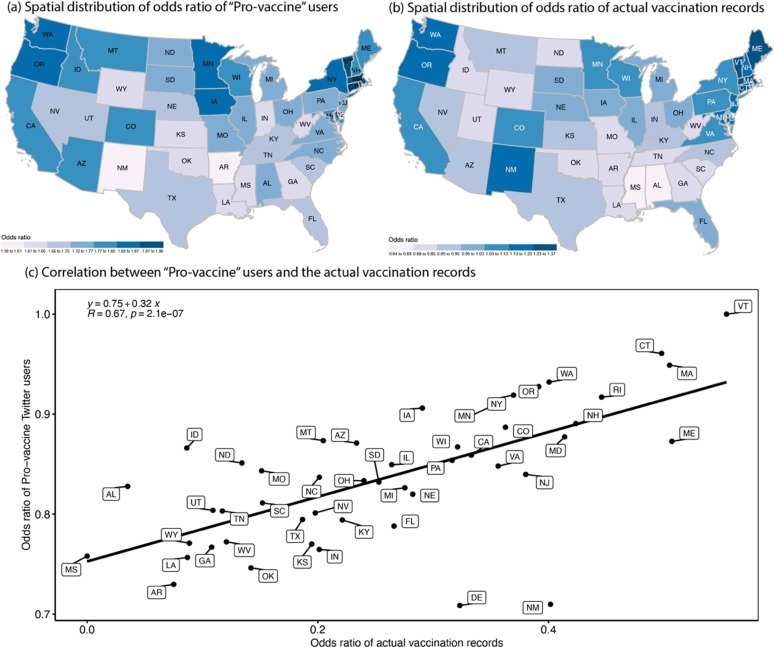
The COVID-19 virus has caused and continues to cause unprecedented impacts on the life trajectories of millions of people globally. Recently, to combat the transmission of the virus, vaccination campaigns around the world have become prevalent. However, while many see such campaigns as positive (e.g., protecting lives), others see them as negative (e.g., the side effects that are not fully understood scientifically), resulting in diverse sentiments towards vaccination campaigns. In addition, the diverse sentiments have seldom been systematically quantified let alone their dynamic changes over space and time. To shed light on this issue, we propose an approach to analyze vaccine sentiments in space and time by using supervised machine learning combined with word embedding techniques. Taking the United States as a test case, we utilize a Twitter dataset (approximately 11.7 million tweets) from January 2015 to July 2021 and measure and map vaccine sentiments (Pro-vaccine, Anti-vaccine, and Neutral) across the nation. In doing so, we can capture the heterogeneous public opinions within social media discussions regarding vaccination among states. Results show how positive sentiment in social media has a strong correlation with the actual vaccinated population. Furthermore, we introduce a simple ratio between Anti and Pro-vaccine as a proxy to quantify vaccine hesitancy and show how our results align with other traditional survey approaches. The proposed approach illustrates the potential to monitor the dynamics of vaccine opinion distribution online, which we hope, can be helpful to explain vaccination rates for the ongoing COVID-19 pandemic.

Keywords: COVID-19, Pandemic, Vaccination Sentiment Analysis, Time and Space, Social Media, United States.

Overview of our research pipeline.

Comparison between Twitter data and Google Trends. (a) Distribution of keywords search and tweets over time; (b) Correlation between Google Trends and Twitter data of keywords search; (c) Important news or announcements catched on Twitter activity (Note: period is the shaded area in (a)).

Correlation between Pro-vaccine users and actual vaccination records (a) Spatial distribution of odds ratio of Pro-vaccine users; (b) Spatial distribution of odds ratio of actual vaccination records; (c) Correlation between the Pro-vaccine users and the actual vaccination records.

Full Reference: 

Chen, Q. and Crooks, A.T. (2022), Analyzing the Vaccination Debate in Social Media Data Pre- and Post-COVID-19 Pandemic, International Journal of Applied Earth Observation and Geoinformation, 110: 102783.  Available at https://doi.org/10.1016/j.jag.2022.102783 (pdf)


Thursday, October 15, 2020

The Impact of Mandatory Remote Work during the COVID-19 Pandemic

In the past we have written about using agent-based modeling to study human resources management issues and how workplace the layout might impact subordinates interactions with managers but with growing amounts data we can explore how employees communicate with each other. To this end, Talha Oz and myself have a  new paper entitled "Exploring the Impact of Mandatory Remote Workduring the COVID-19 Pandemic" which will be presented in a special session on COVID-19 at the 2020 International Conference on Social Computing, Behavioral-Cultural Modeling, & Prediction and Behavior Representation in Modeling and Simulation (or SBP-Brims 2020 for short). 

In this study we exploit metadata (and not content) emitted from commonplace workplace technologies such as calendar and workplace messaging apps collected from a tech company in order to see how mandatory remote work changed communication patterns and how such data can be used to measure organizational health. If this is of interest to you, below we provide the abstract to the paper along with some of the results with respect to how meetings and communication patterns changed from  business as usual (BAU), pre pandemic to that when people were forced to work from home (WFH). Finally at the bottom of the post we provide the full reference and the link to the paper.

Abstract. During the early months of the COVID-19 pandemic, millions of people had to work from home. We examine the ways in which COVID-19 affect organizational communication by analyzing five months of calendar and messaging metadata from a technology company. We found that: (i) cross-level communication increased more than that of same-level, (ii) while within-team messaging increased considerably, meetings stayed the same, (iii) off-hours messaging became much more frequent, and that this effect was stronger for women; (iv) employees respond to non-managers faster than managers; finally, (v) the number of short meetings increased while long meetings decreased. These findings contribute to theories on organizational communication, remote work, management, and flexibility stigma. Besides, this study exemplifies a strategy to measure organizational health using an objective (not self-report based) method. To the best of our knowledge, this is the first study using workplace communication metadata to examine the heterogeneous effects of mandatory remote work. 

Keywords: Work from Home, Communication, COVID-19, Organization.


Full Reference:

Oz, T. and Crooks, A.T. (2020), Exploring the Impact of Mandatory Remote Work during the COVID-19 Pandemic, 2020 International Conference on Social Computing, Behavioral-Cultural Modeling and Prediction and Behavior Representation in Modeling and Simulation, Washington DC. (pdf)
 If you would like a pre-print of  paper, just let us know and we can email you one. 

Friday, August 21, 2009

The spread of pandemics

Following on from some previous posts on the spread of pandemics (1 and 2) such as the swine flu (H1N1) and the recent article in Nature by Joshua Epstein from the Center on Social and Economic Dynamics. I just cam across this movie (below) which explores these issues in a easy to understand way.


The Brookings site is also worth exploring for those interested pandemics and public health.

There is also this spatial model from the Los Alamos National Lab who have modeled Avian flu on a supercomputer which explores vaccine and isolation options for thwarting a pandemic. Full details about the work can be seen here.


On a slightly bizarre side note there was also an interesting article on the BBC entitled "Science ponders 'zombie attack'" where researchers from the University of Ottawa showed if zombies actually existed, an attack by them would lead to the collapse of civilisation unless dealt with quickly and aggressively. The full paper can be read here.

Wednesday, August 05, 2009

Agent-based models in Nature

I just came across a few articles in this weeks Nature about the use of agent-based modelling which I found interesting and thought worth sharing.

To quote Nature, "two Opinion pieces explore the promise of Agent-Based Models (ABMs): J. Doyne Farmer and Duncan Foley on what they can do for economics and Josh Epstein on how the models are being used in pandemic planning. In a News Feature, Mark Buchanan finds out what went so badly wrong with the economy and whether ABMs could have predicted the crunch. These pieces are accompanied by an editorial and an interview on the Nature Podcast."

The discussion of ABM is about 13 minutes into the podcast and well worth listening to as it describes ABM and there potential in a simple way.