Showing posts with label synthetic populations. Show all posts

Monday, March 16, 2026

PySGN: A Python package for constructing synthetic geospatial networks

In previous posts, we have written about the generation of synthetic populations based on real world locations, and how such populations can have various types of networks associated with them. We have also written about network generation techniques in the past and keeping with this line of research, Boyu Wang, Taylor Anderson, Andreas Züfle and myself have a new paper in the Journal of Open Source Software entitled "PySGN: A Python Package for Constructing Synthetic Geospatial Networks"

In this paper we introduce a Python package that can generate geospatial networks which we have called PySGN (Python for Synthetic Geospatial Networks). For readers not familiar with geospatial networks, to quote from the online documentation we have put together:  

Geospatial networks are a type of network where nodes are associated with specific geographic locations. These networks are used to model and analyze spatial relationships and interactions, such as transportation systems, communication networks, and social interactions within geographic constraints. By incorporating spatial data, geospatial networks provide insights into how location influences connectivity and network dynamics.

PySGN generates synthetic geosocial networks that mimic the spatial relationships observed in real‑world networks as it embeds nodes in geographic coordinate space, modifies connection rules to decay with distance, and allows users to incorporate clustering and preferential attachment while respecting spatial constraints. Online we provide examples of creating Geospatial Erdős-Rényi, Watts-Strogatz & Barabási-Albert Networks along with ways to sample points based on a specified bounding box or specific polygon boundaries (examples of which are shown below). 

The package is intended for researchers and practitioners in fields such as urban planning, epidemiology, infrastructure resilience and social science who require robust tools for simulating and analyzing complex geospatial networks. In addition to the paper, we have also made available extensive documentation (along with examples of the various network types) at https://pysgn.readthedocs.io/en/ 

Examples of Geospatial Erdős-Rényi and Watts-Strogatz Networks.

Example of Geospatial Barabási-Albert Network based on different ordering strategies for how nodes are added to the network.

Examples of sampling points based on a bounding box or a specific set of polygons

Full Referece: 

Wang, B., Crooks, A.T., Anderson, T., and Züfle, A. (2026), PySGN: A Python Package for Constructing Synthetic Geospatial Networks. Journal of Open Source Software, 11(119), 9346, https://doi.org/10.21105/joss.09346 (pdf)

Friday, December 12, 2025

Quantitative Comparison of Population Synthesis Techniques

In the past we have written a number of posts on synthetic populations, however, one thing we have not done is compare the various techniques that can be used to create them. This has now changed with a new paper entitled "Quantitative Comparison of Population Synthesis Techniques" which was recently presented at the 2025 Winter Simulation Conference.

In this paper, we (David Han, Samiul IslamTaylor Anderson, Hamdi Kavak and myself) investigate five synthetic population generation techniques (e.g., Iterative Proportional Fitting, Conditional Probabilities, Simple Random Sampling, Hill Climbing and Simulated Annealing) in parallel to synthesize population data for different North America settings (e.g., Fairfax County, VA, USA and Metro Vancouver, BC, Canada). Our findings suggest that while iterative proportional fitting and conditional probabilities techniques perform best, it also suggests at the same time that it is important to consider the basis of choosing certain methods over others for generating synthetic populations with regard to a geographic domain. 

If this sounds of interest, below you can read the abstract to the paper, see some of the figures and tables that support our discussion. While at the bottom of the post you can find the full referece and a link to the paper. Moreover, in an effort to allow for reproducible science,  all code and data are available to interested readers in our GitHub repository located at https://github.com/kavak-lab/synthetic-pop-comparison.

Abstract
Synthetic populations serve as the building blocks for predictive models in many domains, including transportation, epidemiology, and public policy. Therefore, using realistic synthetic populations is essential in these domains. Given the wide range of available techniques, determining which methods are most effective can be challenging. In this study, we investigate five synthetic population generation techniques in parallel to synthesize population data for various regions in North America. Our findings indicate that iterative proportional fitting (IPF) and conditional probabilities techniques perform best in different regions, geographic scales, and with increased attributes. Furthermore, IPF has lower implementation complexity, making it an ideal technique for various population synthesis tasks. We documented the evaluation process and shared our source code to enable further research on advancing the field of modeling and simulation.
A conceptual depiction of the IPF process for population synthesis.

Our four-step process used in this study.

Average R2 values by geographic level and method (standard deviations in italics).

% Total absolute error (% TAE) comparison by attribute for Fairfax County.

Full Referece: 
Han, D., Islam, S., Anderson, T., Crooks, A.T. and Kavak, H. (2025), Quantitative Comparison of Population Synthesis Techniques, in Azar, E., Djanatliev, A., Harper, A., Kogler, C., Ramamohan, V., Anagnostou, A. and Taylor, S.J.E. (eds.), Proceedings of the 2025 Winter Simulation Conference, Seattle, WA, IEEE. pp. 151-162. (pdf)

Thursday, November 06, 2025

HD-GEN: A Software System for Large-Scale Human Mobility Data Generation Based on Patterns of Life


Human mobility datasets are essential for investigating human behavior, mobility patterns, and traffic dynamics.  In the past we have written about how one can use agent-based models to generate patterns of life trajectories datasets. Building on this work at the ACM SIGSPATIAL 2025 conference, we (Hossein AmiriRichard YangShiyang RuanJoon-Seok KimHamdi KavakAndrew Crooks,  Dieter Pfoser,  Carola Wenk and Andreas Züfle) had a paper entitled "HD-GEN: A Software System for Large-Scale Human Mobility Data Generation Based on Patterns of Life"

In this paper, we extend our previous work by introducing a software system that provides a new suite of tools built on top of the Patterns of Life simulation framework. Specifically this work consolidates our contributions into a unified data generation pipeline that includes:

  1. additional discussion of the motivation and applications of large-scale simulated trajectory data, 
  2. detailed instructions on running the simulation and generating datasets, 
  3. extended analysis of the shared dataset, and 
  4. an integrated GitHub repository

The proposed system enables large-scale synthetic dataset generation, either by statistically replicating real-world data or by creating datasets with user-defined properties. If this sounds of interest, below you can read the abstract to the paper, the poster that accompanies it and we have also provided detailed instructions on how to reproduce the generated datasets, and made the code and data available at https://github.com/onspatial/large-scale-dataset-generator.

Abstract

Understanding individual human mobility is critical for a wide range of applications. Real-world trajectory datasets provide valuable insights into actual movement behaviors but are often constrained by data sparsity and participant bias. Synthetic data, by contrast, offer scalability and flexibility but frequently lack realism. To address this gap, we introduce a comprehensive software pipeline for generating, calibrating, and processing large-scale human mobility datasets that integrate the realism of empirical data with the control and extensibility of Patterns-of-Life simulations. Our system consists of three integrated components. First, a genetic algorithm–based calibration module fine-tunes simulation parameters to align with real-world mobility characteristics, such as daily trip counts and radius of gyration, enabling realistic behavioral modeling. Second, a data generation engine constructs geographically grounded simulations using OpenStreetMap data to produce diverse mobility logs. Third, a data processing suite transforms raw simulation logs into structured formats suitable for downstream applications, including model training and benchmarking. 

Keywords: GeoLife, Patterns of Life, Simulation, Realistic Trajectory Datasets

Dataset creation phases with HD-GEN software.

Full Reference: 

Hossein, A., Yang, R.,  Ruan, S., Kim, J-S., Kavak, H., Crooks, A.T., Pfoser, D., Wenk, C. and Züfle, A., (2025). HDGEN: A Software System for Large-Scale Human Mobility Data Generation Based on Patterns of Life. In The 33rd ACM International Conference on Advances in Geographic Information Systems (SIGSPATIAL ’25), November 3–6, 2025, Minneapolis, MN. pp. 407-410. (pdf) (poster)

Saturday, December 14, 2024

AGU

This past week we attended the American Geophysical Union (AGU) Fall Meeting in Washington DC. At the AGU we presented two abstracts. 

The first follows on our work with respect to using synthetic populations within agent-based models. This work was with Na Jiang, Fuzhen Yin and Boyu Wang and entitled "A Framework for Populating Urban Digital Twins with Agents." Or more specially why digital twins need agents. Below you can see our abstract and a couple of figures showing our synthetic population workflow and how we integrate these into agent-based models.  

Abstract:

Over the last few years, considerable efforts have been placed in creating digital twins from diverse fields ranging from engineering to urban planning and many things in-between. These digital twins have benefited from the growth and availability of computational power and data. For example, in urban planning the growth of computational resources and the explosion of spatial data sources(e.g. remote sensing) has lead to the creation and widespread adoption of detailed virtual urban environments or urban digital twins. However, we would argue that many of such works emphasize only the physical infrastructure or the built environment of the city instead of considering the key actors of urban systems: the people who live in them. In this work we aim to remedy this by introducing a framework that utilizes agent-based modeling to add humans to such urban digital twins. This framework consists of two components: 1)synthetic populations generated with census data; and 2) pipeline of using the population datasets for agent-based modeling applications within the urban digital twins domain. To demonstrate the utility of this framework, we have representative applications that showcase how digital twins can be created to study various urban phenomena (e.g., evacuation scenarios, traffic congestion and disease transmission). By doing so, we believe this framework will benefit researchers wishing to build urban digital twins and to explore complex urban issues with realistic populations. 


Workflow of utilizing synthetic populations within agent-based models.
Examples of agent-based models utilizing our synthetic popuation.

In a different presentation, we return to how one can use social media to monitor the world around us, in this case dust storms. This work entitled "Mining unconventional data sources: creating a social media-based catalog of dust events in the Western US" is collaboration with Stuart Evans and Festus Adegbola. Generally speaking we explore how social media has the potential for a new unconventional source of observations of windblown dust. If this sounds of interest, below you can read the abstract to the paper and see the visual overlap between social media posts about dust events and official National Weather Service (NWS) dust storm warning coverage. 

Abstract 

Complete observations of dust events are difficult, as dust’s spatial and temporal variability means satellites may miss dust due to overpass time or cloud coverage, while ground stations may miss dust due to not being in the plume. As a result, an unknown number of dust events go unrecorded in traditional datasets. Dust’s importance both for atmospheric processes and as a health and travel hazard makes detecting dust events whenever possible important, and in particular, studies of the health impacts of dust are limited by detailed exposure information, i.e. where is there dust and when. In recent years, social media platforms have provided an opportunity to access vast user-generated data. This research utilizes geotagged Flickr and Twitter posts referencing dust in the western US, and compares it to traditional datasets including blowing dust reports from the National Weather Service and satellite observations from Suomi-VIIRS. Results show that this unconventional dataset broadly recreates the observed spatial and seasonal distributions of dust. Daily analysis of the locations of the social media posts creates a novel catalog of dust events in the western US that can be used for further research. While this catalog is necessarily incomplete, it nonetheless provides a complementary list of events to those detected by traditional means. Analysis of individual events in this catalog shows that social media captures many dust events that previously went undetected by traditional datasets.


References:

Crooks, A.T., Jiang, N., Yin, F. and Wang, B. (2024), A Framework for Populating Urban Digital Twins with Agents, American Geophysical Union (AGU) Fall Meeting, 9th–13th December, Washington, DC. (pdf)

Evans, S., Adegbola, F. and Crooks, A.T. (2024), Mining Unconventional Data Sources: Creating a Social Media-based Catalog of Dust Events in the Western US, American Geophysical Union (AGU) Fall Meeting, 9th–13th December, Washington, DC. (pdf)

Thursday, November 07, 2024

A Large-Scale Geographically Explicit Synthetic Population with Social Networks for the US

In numerous posts, we have been discussing synthetic populations and their use in agent-based modeling. But there are many modeling styles that also utilize synthetic populations. In our own work we often spend significant amounts of time creating such synthetic populations, especially those grounded with data, due to the time needed to collect, preprocess and generate the final synthetic population. To alleviate this, we (Na (Richard) JiangFuzhen YinBoyu Wang and myself) have a new paper published in Scientific Data, entitled "A Large-Scale Geographically Explicit Synthetic Population with Social Networks for the United States.Our aim of this paper is to build and provide a geographically explicit synthetic population along with its social networks using open data including that from the latest 2020 U.S. Census which can be used in a variety of geo-simulation models.

Summary of the Resulting Datasets.

Specially, in the paper we outline how we created the a synthetic population of 330,526,186 individuals representing America's 50 states and Washington D.C.. Each individual has a set of geographical locations that represent their home, work or school addresses. Additionally, these individuals are not isolated, they are embedded in a larger social setting based on their household, working and studying relationships (i.e., social networks).

The work (e.g., data collection, data preprocessing and generation processes) was coded using Python 3.12 and all the scripts used are available at: https://github.com/njiang8/geo-synthetic-pop-usa while the resulting datasets (85 GB uncompressed) are available at OSF: https://osf.io/fpnc2/.  

To give you a sense of the paper, below we provide the abstract to it, along with  some results and our efforts to validate the synthetic population. While at the full reference and link to the paper can be found at the bottom of the post. 

Abstract:

Within the geo-simulation research domain, micro-simulation and agent-based modeling often require the creation of synthetic populations. Creating such data is a time-consuming task and often lacks social networks, which are crucial for studying human interactions (e.g., disease spread, disaster response) while at the same time impacting decision-making. We address these challenges by introducing a Python based method that uses the open data including that from 2020 U.S. Census data to generate a large-scale realistic geographically explicit synthetic population for America's 50 states and Washington D.C. along with the stylized social networks (e.g., home, work and schools). The resulting synthetic population can be utilized within various geo-simulation approaches (e.g., agent-based modeling), exploring the emergence of complex phenomena through human interactions and further fostering the study of urban digital twins.

Keywords: Synthetic Population, U.S. Census 2020, Agent-Based Modeling, Geo-Simulation, Social Networks.

Data Generation Workflow and Resulting Datasets.

A Sample of a Social Networks for one Household and their Home, Work and Educational Social Networks from the Generated Data.

Sample of Generated Social Networks Extracted from the City of Buffalo, New York: (a) Household; (b) Work; (c) School; (d) Daycare.

Validation of the Synthetic Population at Different Levels: (a) Population under Different 18 Age Groups; (b) Household under Different Household Types.

Full Referece: 

Jiang, N., Yin, F., Wang., B. and Crooks, A.T., (2024), A Large-Scale Geographically Explicit Synthetic Population with Social Networks for the United States, Scientific Data, 11, 1204. https://doi.org/10.1038/s41597-024-03970-1 (pdf)


Thursday, October 31, 2024

Studying Contagious Disease Spread: An ABM Framework

In the past we have written about the use of synthetic populations and their use in agent-based models. We are finding such synthetic populations to be extremely useful in the creation or initialization of agent-based models. To give you a sense of how we are utilizing such synthetic populations at the 7th ACM SIGSPATIAL International Workshop on Geospatial Simulation (GeoSim 2024),   Na (Richard) Jiang and myself have a new paper entitled  "Studying Contagious Disease Spread Utilizing Synthetic Populations Inspired by COVID-19: An Agent-based Modeling Framework.

In the paper we show how we can we utilize a method to create the geographically-explicit synthetic population along with capturing their social networks and how this can be used to study  contagious disease spread (and various lineages of the disease) in Western New York. If this sounds of interest, below you can read the abstract from the paper, see some of the results and find the full reference and the link to the paper. While the model itself and the data needed to run it is available at https://osf.io/zrtuj/

Abstract

The COVID-19 pandemic has reshaped societies and brought to the forefront simulation as a tool to explore the spread of the diseases including that of agent-based modeling. Efforts have been made to ground these models on the world around us using synthetic populations that attempt to mimic the population at large. However, we would argue that many of these synthetic populations and therefore the models using them, miss the social connections which were paramount to the spread of the pandemic. Our argument being is that contagious diseases mainly spread through people interacting with each other and therefore the social connections need to be captured. To address this, we create a geographically-explicit synthetic population along with its social network for the Western New York (WNY) Area. This synthetic population is then used to build a framework to explore a hypothetical contagious disease inspired by various of COVID-19. We show simulation results from two scenarios utilizing this framework, which demonstrates the utility of our approach capturing the disease dynamics. As such we show how basic patterns of life along with interactions driven by social networks can lead to the emergence of disease outbreaks and pave the way for researchers to explore the next pandemic utilizing agent-based modeling with geographically explicit social networks.

Keywords: Agent-based Modeling, Synthetic Populations, Social Networks, COVID-19, Disease Modeling.

Single Lineage Results: (a) Overall SEIR Dynamic; (b) Contact Tracing Example.

Western New York Commuting Pattern.

Disease Dynamics when Two Lineages are Introduced.

Reference: 

Jiang N., Crooks, A.T. (2024), Studying Contagious Disease Spread Utilizing Synthetic Populations Inspired by COVID-19: An Agent-based Modeling Framework, Proceedings of the 7th ACM SIGSPATIAL International Workshop on Geospatial Simulation (GeoSim 2024), Atlanta, GA., pp. 29-32. (pdf)

Friday, November 03, 2023

Geographically Synthetic Populations for ABM: A Gallery of Applications

Often we are building geographically explicit agent-based models we spend a lot of time creating the synthetic population to instantiate our artificial world. We have tired to overcome this with creating methods to generate such populations (see this old blog post). Building on this work, Na (Richard) Jiang, Fuzhen Yin, Boyu Wang and myself have a new paper entitled "Geographically-Explicit Synthetic Populations for Agent-based Models: A Gallery of Applications" which was presented at 2023 Computational Social Science Society of the Americas conference. In the paper we extend the synthetic population to the whole of New York state. While at the same time we introduce a pipeline for using the population datasets for model initialization. To show this pipeline, we present several case studies utilizing Python and Mesa. These models range from that of commuting to disease spread and vaccination uptake. If this sounds of interest, below we provide the abstract to the paper along with some of the key figures including our pipeline and example applications. At the bottom of the page we provide the full reference and a link to the paper which has links to the models and data.
Abstract: Over the last two decades, there has been a growth in the applications of geographically-explicit agent-based models. One thing such models have in common is the creation of synthetic populations to initialize the artificial worlds in which the agents inhabit. One challenge such models face is that it is often difficult to create reusable geographically-explicit synthetic populations with social networks. In this paper, we introduce a Python based method that generates a reusable geographically-explicit synthetic population dataset along with its social networks. In addition, we present a pipeline for using the population datasets for model initialization. With this pipeline, multiple spatial and temporal scales of geographically-explicit agent-based models are presented focusing on Western New York. Such models not only demonstrate the utility of our synthetic population on commuting patterns but also how social networks can impact the simulation of disease spread and vaccination uptake. By doing so, this pipeline could benefit any modeler wishing to reuse synthetic populations with realistic geographic locations and social networks. 
Keywords: Agent-Based Model, Geographically-Explicit Agent-Based Models, Synthetic Population, Python, Mesa.
Pipeline of Utilizing Synthetic Population Resulting Datasets in Agent-Based Models.

Large Scale Disease Spread Model Structure.

Disease Dynamics for Two Diseases.

Vaccination Opinion Dynamic Model.

Simulation Vaccination Rate v.s. Real Vaccination Records: (A) All Population; (B) Different Age Groups of Population.

Full Referece: 

Jiang, N., Crooks, A.T., Yin, F. and Wang B. (2023), Geographically-Explicit Synthetic Populations for Agent-based Models: A Gallery of Applications, Proceedings of the 2023 Conference of The Computational Social Science Society of the Americas, Santa Fe, NM. (pdf)

Thursday, February 17, 2022

New Paper: Synthetic Populations with Social Networks

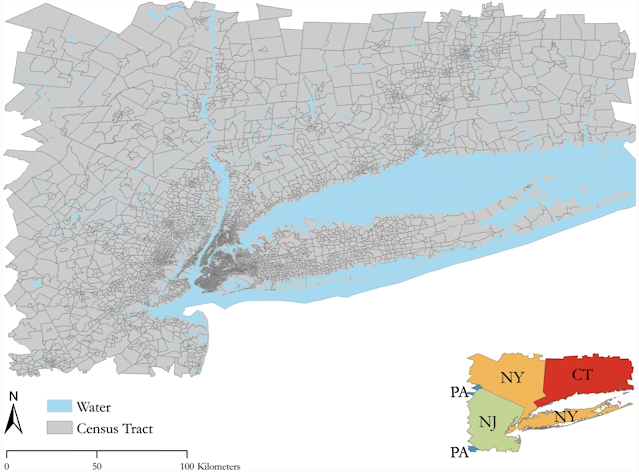
When developing geographically explicit agent-based models, one thing we spend a lot of time on is building synthetic populations and then linking the agents in the synthetic population to each other.  To overcome this issue we have a new paper published in "Computational Urban Science " entitled "A method to create a synthetic population with social networks for geographically-explicit agent-based models" In this paper  Na (Richard) Jiang, Hamdi Kavak, Annetta Burger, William Kennedy and myself present a synthetic population generation method that also includes social networks and use the New York Metro as a study site, which covers an area of 262 x 234 km and is home to over 23 million people. 

To show the utility of this method we also present three simple applications (e.g., a disease , a disaster  and a traffic model) which utilize different parts of this synthetic population but are all geographically explicit and use networks in some shape or form. If this sounds of interest, below you can read the abstract from the paper, along with seeing some of the figures from our methodology and example applications. While at the bottom of the post we provide the full citation and a link to the paper. The paper itself also has links to actual code that generates the synthetic population and the resulting datasets and models  (code: https://bit.ly/SynPopABM; source and resulting synthetic population data: https://osf.io/3vsaj/) .  

Abstract

Geographically-explicit simulations have become crucial in understanding cities and are playing an important role in urban science. One such approach is that of agent-based modeling which allows us to explore how agents interact with the environment and each other (e.g., social networks), and how through such interactions aggregate patterns emerge (e.g., disease outbreaks, traffic jams). While the use of agent-based modeling has grown, one challenge remains, that of creating realistic, geographically-explicit, synthetic populations which incorporate social networks. To address this challenge, this paper presents a novel method to create a synthetic population which incorporates social networks using the New York Metro Area as a test area. To demonstrate the generalizability of our synthetic population method and data to initialize models, three different types of agent-based models are introduced to explore a variety of urban problems: traffic, disaster response, and the spread of disease. These use cases not only demonstrate how our geographically-explicit synthetic population can be easily utilized for initializing agent populations which can explore a variety of urban problems, but also show how social networks can be integrated into such populations and large-scale simulations.

Keywords: Synthetic Population Generation, Agent-Based Modeling, New York, Traffic Dynamics, Disease, Disaster

Study Area

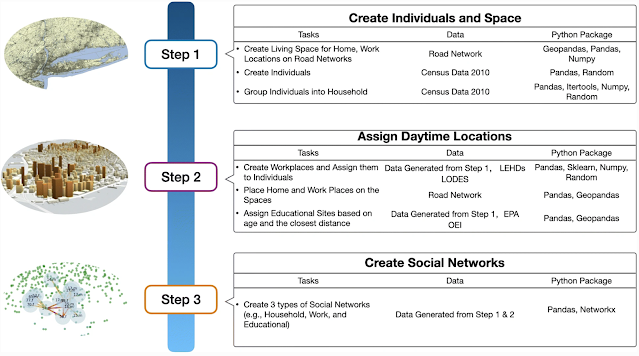
Workflow for Generation of Synthetic Population and Networks

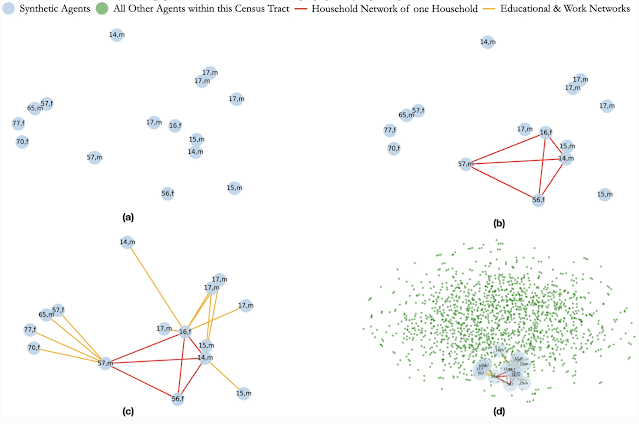
Creation of Social Networks: (a) Selected Population; (b) Creation of a Household Network; (c) Creation of Work and Educational Networks for each Member of the Household; (d) The Household, its Networks within the Full Census Tract

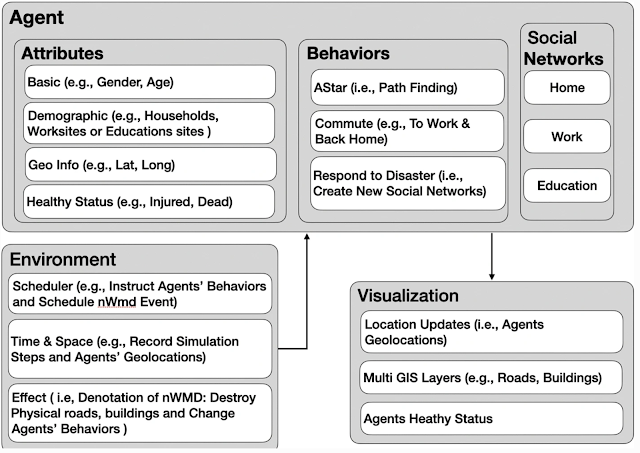
Model Component Structure of Population Respond to Disaster event

Agents’ Health Status After 1 Minute of the Disaster Event

Full Reference:

Jiang, N., Crooks, A.T., Kavak, H., Burger, A. and Kennedy, W.G. (2022), A Method to Create a Synthetic Population with Social Networks for Geographically Explicit Agent-Based Models, Computational Urban Science, 2:7. Available at https://doi.org/10.1007/s43762-022-00034-1

Monday, June 29, 2020

Location-Based Social Network Data Generation

Continuing and building upon our previous work on Location-Based Social Networks (LBSNs) at the The 21st IEEE International Conference on Mobile Data Management we have a paper entitled "Location-Based Social Network Data Generation Based on Patterns of Life." In the paper we discuss how LBSNs research has become an active research topic in a variety of areas describing mobility patterns, location recommendation and friend recommendation systems. However we make the argument that real-world LBSN data sets (e.g., Gowalla, BrightKite) are a rather scarce resource due to privacy implications of making such data public available. Furthermore, in many publicly available LBSN data sets, the vast majority of users have less than ten check-ins or the number of locations visited by a user is usually only a small portion of all locations that user has visited (as shown in the table below).

Publicly Available Real-World LBSN Data Sets.

To overcome these weaknesses in this paper we present a LBSN simulation (an agent-based model created in MASON) capable of creating multiple artificial but socially plausible, large-scale LBSN data sets. If this sounds of interest to you, below we provide a little more information about the paper, Specifically, its abstract, a depiction of LBSNs, our case studies and the resulting simulations we used to develop LBSN data based on patterns of life (PoL) and some sample results. In addition to this, as the conference was virtual, Joon-Seok Kim also made a great movie of the conference paper. At the bottom of this post we provide the full reference and link to the paper. 

We would also like to draw the readers attention to our online resources which accompanies this paper. For example, to allow others to use and extend our work, the source code and scripts used to generate these data sets is available at: https://github.com/gmuggs/pol, while all of the generated data sets can be found at OSF (https://osf.io/e24th/?view_only=191fdd0c640847b5b85597ab0e57186d). For more details about this model and data readers are referred to the webpage created by Joon-Seok Kim: https://mdm2020.joonseok.org.

Abstract:
Location-based social networks (LBSNs) have been studied extensively in recent years. However, utilizing real-world LBSN data sets in such studies yields several weaknesses: sparse and small data sets, privacy concerns, and a lack of authoritative ground-truth. To overcome these weaknesses, we leverage a large scale LBSN simulation to create a framework to simulate human behavior and to create synthetic but realistic LBSN data based on human patterns of life. Such data not only captures the location of users over time but also their interactions via social networks. Patterns of life are simulated by giving agents (i.e., people) an array of “needs” that they aim to satisfy, e.g., agents go home when they are tired, to restaurants when they are hungry, to work to cover their financial needs, and to recreational sites to meet friends and satisfy their social needs. While existing real-world LBSN data sets are trivially small, the proposed framework provides a source for massive LBSN benchmark data that closely mimics the real-world. As such it allows us to capture 100% of the (simulated) population without any data uncertainty, privacy-related concerns, or incompleteness. It allows researchers to see the (simulated) world through the lens of an omniscient entity having perfect data. Our framework is made available to the community. In addition, we provide a series of simulated benchmark LBSN data sets using different real-world urban environments obtained from OpenStreetMap. The simulation software and data sets which comprise gigabytes of spatio-temporal and temporal social network data are made available to the research community.
LBSN Overview

Case Studies: A: New Orleans, Louisiana (NOLA), Mississippi River, Lake Pontchartrain, and the ‘French Quarter’. B: George Mason University (GMU), Fairfax, VA. C: Synthetic Villages - Small (Left) and Large (Right).
Environments Populated with Agents. Clockwise from Top Left: GMU, NOLA, Large and Small Synthetic Villages.
Data Sets Resulting from Location-Based Social Network Simulation
Average Social Network Degree over Time (1K).
Social Network


Full Reference:
Kim, J-S., Jin, H., Kavak, H., Rouly, O.C., Crooks, A.T., Pfoser, D., Wenk, C. and Züfle, A. (2020), Location-Based Social Network Data Generation Based on Patterns of Life, The 21st IEEE International Conference on Mobile Data Management, Versailles, France. (pdf)

Saturday, October 07, 2017

Generation of Realistic Mega-City Populations and Social Networks for ABM


At the upcoming 2017 Annual conference of the Computational Social Science Society of the Americas, Annetta Burger, Talha Oz, William Kennedy and myself have a paper entitled: "Generation of Realistic Mega-City Populations and Social Networks for Agent-Based Modeling". 

In the paper we discuss some of our current work of generating synthetic human populations with realistic social networks with respect to the New York mega-city and surrounding region. Below you can read the abstract of the paper and see our workflow along with some initial results. The full reference to the paper and a link to the pdf can be found at the bottom of the post.


Abstract:
Agent-based modeling is a means for researchers to conduct large-scale computer experiments on synthetic human populations and study their behaviors under different conditions. These models have been applied to questions regarding disease spread in epidemiology, terrorist and criminal activity in sociology, and traffic and commuting patterns in urban studies. However, developing realistic control populations remains a key challenge for the research and experimentation. Modelers must balance the need for representative, heterogeneous populations with the computational costs of developing large population sets. Increasingly these models also need to include the social network relationships within populations that influence social interactions and behavioral patterns. To address this we used a mixed method of iterative proportional fitting and network generation to build a synthesized subset population of the New York megacity and region. Our approach demonstrates how a robust population and social network relevant to specific human behavior can be synthesized for agent-based models. 

Keywords: Agent-based Models, Geographical Systems, Population Synthesis, Social Networks, Megacity.


Full Reference: 
Burger, A., Oz, T., Crooks, A.T. and Kennedy, W.G. (2017). Generation of Realistic Mega-City Populations and Social Networks for Agent-Based Modeling, The Computational Social Science Society of Americas Conference, Santa Fe, NM. (pdf)