Showing posts with label Topic Modeling. Show all posts

Wednesday, September 02, 2026

EPB: Collaborations and Topics Over Decade

When Environment and Planning B: Urban Analytics (EPB) turned 50 we wrote a short commentary about how the topics in the journal have evolved over the years. In the latest issue of the journal we (Na Jiang, Joana Barros, Seraphim Alvanides, Jinlin Wu and myself) revisited this, while at the same time explored how collaborations and topics have been evolving along with how this links to the new Editorial Advisory Board which has recently been selected to reflect the journal’s thematic areas of focus and the breadth of expertise needed to guide it into the future. 

If you wish to find out more, we encourage you to read the commentary (a link is provided at the bottom of this post). However, to give a sense of some of the things we explore, below we show some of the images relating to the commentary ranging from our workflow to some of our results from the analysis of authors, paper titles and abstracts, and how through topic modeling and community detection we can explore how the collaboration networks and topics have changed over time. 

The workflow.
 
Visualization of the EPB author network.

Evolution of the largest 10 communities by decade: (a) The Number of Active Members; (b) The Number of Papers Published; (c) Michael Batty’s Collaboration Network.

Topics evolution overtime.
Full reference: 

Crooks, A.T., Jiang, N., Barros, J., Alvanides, S., & Wu, J. (2026). Environment and Planning B: Collaborations and Topics Over Decades, Environment and Planning B, 53(6), 1189-1199. https://doi.org/10.1177/23998083261474805. (pdf)

Thursday, February 06, 2025

From print to perspective: A mixed-method analysis of the convergence and divergence of COVID-19 topics in newspapers and interviews

In previous posts we have noted how one can explore urban issues through newspapers, while at the same time we have used social media to explore trends in vaccinations. In a recently published paper in PLOS Digital Health entitled "From print to perspective: A mixed-method analysis of the convergence and divergence of COVID-19 topics in newspapers and interviews" with Qingqing Chen, Adam Sullivan, Jennifer Surtees, Laurene Tumiel-Berhalter and myself, we thought we would explore how COVID-19 was reported in newspapers and how this varied from interviews. 

The rationale behind this was that the COVID-19 pandemic has led to diverse experiences influenced by public health measures like lockdowns and social distancing. To explore these dynamics, we introduce a novel ’big-thick’ data approach that integrates extensive U.S. newspaper data with detailed interviews. By employing natural language processing (NLP) and geoparsing techniques, we identify key topics related to the pandemic and vaccinations both in newspapers and personal narratives from interviews, and compare the (spatial) convergences and divergences between them. 

We found that both sources converge to highlight the profound impacts of the pandemic on daily life. However, newspapers provide a macro-level perspective, predominately covering policy, public health efforts and economics, while interviews reveal the nuanced impacts at the micro-level, focusing on personal experiences, emotion and concerns. An intriguing finding is the pronounced concern regarding the reliability of news information from interviews. By showcasing both convergences and divergences in identified topics, our study enhances the understanding of key issues that both disseminated to and resonate with the public, contributing to the development of more effective communication strategies for future public health crises.

If this sounds of interest, below you can read the abstract to the paper, see some of the figures which include our workflow and some of the results. At the bottom of the post you can see the full reference and a link to the actual paper. While at https://figshare.com/s/339b1c0d059c189dd6a4?file=44583661 you can find the code we used for our analysis. 

Abstract:

In the face of the unprecedented COVID-19 pandemic, various government-led initiatives and individual actions (e.g., lockdowns, social distancing, and masking) have resulted in diverse pandemic experiences. This study aims to explore these varied experiences to inform more proactive responses for future public health crises. Employing a novel “big-thick” data approach, we analyze and compare key pandemic-related topics that have been disseminated to the public through newspapers with those collected from the public via interviews. Specifically, we utilized 82,533 U.S. newspaper articles from January 2020 to December 2021 and supplemented this “big” dataset with “thick” data from interviews and focus groups for topic modeling. Identified key topics were contextualized, compared and visualized at different scales to reveal areas of convergence and divergence. We found seven key topics from the “big” newspaper dataset, providing a macro-level view that covers public health, policies and economics. Conversely, three divergent topics were derived from the “thick” interview data, offering a micro-level view that focuses more on individuals’ experiences, emotions and concerns. A notable finding is the public’s concern about the reliability of news information, suggesting the need for further investigation on the impacts of mass media in shaping the public’s perception and behavior. Overall, by exploring the convergence and divergence in identified topics, our study offers new insights into the complex impacts of the pandemic and enhances our understanding of key issues both disseminated to and resonating with the public, paving the way for further health communication and policy-making.
An overview of the research workflow.

The monthly distribution of collected articles in the United States from January 2020 to December 2021.

An example of identified entities labeled with predefined entity types.

The spatial distribution of newspaper articles by different scales.


The spatial distribution of identified newspaper topics across different regions in New York State.

Ordered rank of identified topics by percentage from interviews.

Full reference:
Chen, Q., Crooks, A.T., Sullivan, A.J., Surtees, J.A. and Tumiel-Berhalter, L. (2025). From Print to Perspective: A mixed-method analysis of the convergence and divergence of COVID-19 topics in newspapers and interviews, PLOS Digital Health. Available at https://doi.org/10.1371/journal.pdig.0000736. (pdf)

Tuesday, May 28, 2024

EPB turns 50

Its hard to believe that Environment and Planning B (EPB) is turning 50. To celebrate the fact, we have a special issue. Among the many number of contributed commentaries and editorials Mike Batty discusses the history of the journal, and I have a paper that reflects  on how EPB (and the authors who have published in it has shaped my own thinking of cities.  

We also have another commentary with Na (Richard) Jiang and the current editors of the journal (Linda See, Seraphim Alvanides, Dani Arribas-Bel, Levi Wolf, Mike Batty and myself) that  explore papers published in the journal over the last 50 years. By taking the abstracts from all the papers, we did some content analysis to look at the trends and themes over the decades. To some extent it was not surprising seeing a rising number of publications over the decades and the decrease in number of single authors papers. But what was quite evident by just generating some word clouds of the key terms in the abstracts, is one one can see that ‘design’, ‘analysis’ and ‘development’ have remained as key concepts throughout the 50 years as shown below.

The top 50 words appearing in the titles of all 50 years and from the 1970s to 2020s

We also dug deeper into the abstracts by using Bidirectional Encoder Representations from Transformers (BERT) framework, which looks for relationships between words among different abstracts. BERTopic was used to classify all abstracts into 40 topics including one irrelevant or outlier topic. By excluding this outlier topic, 39 topics  emerged. These topics give a good overview of the types of papers that have appeared in EPB over the last 50 years as shown below. 

The evolution of topics over time based on topic modeling.

From the topic modeling, one can see the architectural history of the journal and the publication of quite specialized papers on shape grammars which is evident in topics 2, 5, 13, 14, and 17 while models of urban growth (topic 0) represent one of the main topics of research in the journal over time. Other topics represent emerging challenges, for example, topic 15 on the covid pandemic and topic 7 on climate change related research. If you wish to find out more about this analysis have a look at the commentaries listed below. 

References: 
Crooks, A.T. (2024), Environment and Planning B: Its Shaping of Urban Modeling and Me, Environment and Planning B, 51(5) 1020-1022. (pdf)
Crooks, A.T., Jiang, N., See, L. Alvanides, S., Arribas-Bel. D., Wolf, L.J. and Batty, M. (2024), EPB Turns 50 Years Old: An Analytical Tour of the Last Five Decades, Environment and Planning B, 51(5): 1028-1037. (pdf)

Wednesday, October 04, 2023

Leveraging newspapers to understand urban issues

In the past, this blog has explored several aspects of Detroit, such as how well its covered with Volunteered Street View Imagery or how through the use of agent-based models one can explore issues with urban shrinkage. Keeping up with the theme of shrinkage and Detroit but at the same time utilizing our growing interest in natural language processing (especially topic modeling) we (Na (Richard) Jiang, Hamdi Kavak, Wenjing Wang and myself) have a new paper entitled "Leveraging newspapers to understand urban issues: A longitudinal analysis of urban shrinkage in Detroit" published in Environment and Planning B. 

In the paper, we take 6794 English news articles published by national and local press organizations (e.g., Forbes, The New York Times, Newsweek, The Detroit News) between 1975 to 2021 using the keywords “Detroit”, “shrink” and “decline.” These keywords were selected based on the characteristics of the study area (i.e., Detroit) and the phenomenon of urban shrinkage. With these data we then use BERTopic to detect and classify all collected news articles into certain topics. We chose BERTopic because it captures the semantic relationship among words converting sentences and words to embedding and automatically generates the topic unlike other NLP topic modeling techniques (e.g., LDA). Our topic modeling results identify several insights with respect to Detroit's shrinkage. For example, we can detect the side effects of the 2007-2009 economic recession on Detroit's automobile industry, local employment status, and the housing market. If sounds of interest and you want to find out more, below we provide the abstract, some figures from the paper including the methodology workflow and an example of the resulting topics over time. Finally, at the bottom of the page you can see the full reference and s link to the paper itself.

Abstract 

Today we are awash with data, especially when it comes to studying cities from a diverse data ecosystem ranging from demographic to remotely sensed imagery and social media. This has led to the growth of urban analytics providing new ways to conduct quantitative research within cities. One area that has seen significant growth is using natural language processing techniques on text data from social media to explore various issues relating to urban morphology. However, we would argue that social media only provides limited insights when dealing with longer-term urban phenomena, such as the growth and shrinkage of cities. This relates to the fact that social media is a relatively recent phenomenon compared to longer-term urban problems that take decades to emerge. Concerning longer-term coverage, newspapers, which are increasingly becoming digitized, provide the possibility to overcome the limitations of social media and provide insights over a timeframe that social media does not. To demonstrate the utility of newspapers for urban analytics and to study longer-term urban issues, we utilize an advanced topic modeling technique (i.e., BERTopic) on a large number of newspaper articles from 1975 to 2021 to explore urban shrinkage in Detroit. Our topic modeling results reveal insights related to how Detroit shrinks. For example, side effects of 2007 to 2009 economic recessions on Detroit’s automobile industry, local employment status, and the housing market. 

Key Words: Natural Language Processing, Topic Modeling, Newspapers, Urban Shrinkage, Urban Analytics.


 Vacancy status change from 1970 to 2010 for city of Detroit and surrounding area.
Topic modeling work flow.
Topics over time (a) urban, (b) population, (c) shrinkage, (d) economy, (e) job, (f) house.

Full Reference:

Jiang, N., Crooks, A.T., Kavak, H. and Wang, W. (2023), Leveraging Newspapers to Understand Urban Issues: A Longitudinal Analysis of Urban Shrinkage in Detroit, Environment and Planning B. Available at https://doi.org/10.1177/23998083231204695. (pdf)

Wednesday, March 22, 2023

AAG 2023 Presentations

At this years Association of American Geographers (AAG) Annual Meeting we have a number of presentations ranging from how one can leverage newspaper articles to study cities over time, to that of how people may chose to become vaccinated. These presentations build on the great work of students and postdocs here at the University at Buffalo and link to our interests in urban analytics, machine learning and agent-based modeling. Below we just give a glimpse at these topics (along with their abstracts) and if you are interested in finding out more please reach out to us.

First up is a presentation with Qingqing Chen and Boyu Wang entitled "Community resilience to wildfires: A network analysis approach utilizing human mobility data."  In this presentation we explore how we can quantify a communities resilience to wildfires utilizing human mobility through network analysis methods. 

Abstract 

Natural disasters, such as earthquakes, floods, and wildfires, have been a long-standing concern to societies at large. With growing attention being paid to sustainable and resilient communities, such concern has been brought to the forefront of resilience studies. However, the definition of disaster resilience is intricate and can vary across the diverse disciplines that study them (e.g., geography, sociology and political science), making its definition and quantification elusive. Moreover, the vast majority of studies often focus on the immediate response to an event, not the long-term recovery of the area impacted by disasters. Thus to date investigating the resilience of an area or a society over a prolonged period of time has remained largely unexplored. To overcome these issues, we propose a novel approach from a social perspective utilizing network analysis and concepts from disaster science (e.g., the resilience triangle) to quantify the long-term impacts of wildfires, especially on collective human behavior. Taking the Camp and Mendocino Complex wildfires - the most deadly and the largest complex wildfires in California to date, respectively - as case studies, we capture the features of resilience, such as robustness and vulnerability, of communities based on human mobility data from 2018 to 2020. The results show that demographic and socioeconomic characteristics alone only partially capture community resilience, however, by leveraging human mobility data and network analysis techniques, we can enhance our understanding of resilience over space and time, which can provide a new lens to study natural disasters and their long-term impacts on society.

Keywords: Community Resilience, Natural Disasters, Wildfires, Social Network Analysis, Human Mobility, Space and Time.

Full Reference

Chen, Q., Wang, B. and Crooks, A.T. (2023), Community Resilience to Wildfires: A Network Analysis Approach Utilizing Human Mobility Data, The Association of American Geographers (AAG) Annual Meeting, 23rd –27th March, Denver, CO. (pdf)

Next up, moving from mobility to textural data, specifically that of newspapers Na (Richard) Jiang and myself have a presentation entitled "Leveraging Newspapers to Understand Urban Issues: A Longitudinal Analysis of Urban Shrinkage in Detroit". In this work we explore how can leverage Bertopic (a topic modeling technique) on newspaper articles spanning the years 1975 to 2021 to explore urban shrinkage in Detroit. 


Abstract 

Today we are awash with data especially when it comes to studying cities from a diverse data ecosystem ranging from demographic to that of remotely sensed imagery and social media. This has led to the growth of geographical data science and urban analytics providing new ways to conduct quantitative research within cities. One area that has seen significant growth is that of using natural language processing techniques on text data from social media to explore various issues relating to urban morphology. However, social media only provides limited insights when dealing with longer-term urban phenomena, such as the growth and shrinkage of cities. This relates to the fact that social media is a relatively recent phenomenon compared to more longer-term urban problems that take decades to emerge. With respect to the longer-term coverage, newspapers which are increasingly becoming digitized provide the possibility to overcome the limitations of social media and provide insights over a timeframe that social media does not. To demonstrate the utilization of newspapers within urban analytics and to study longer-term urban issues, we present an advanced topic modeling technique (i.e., Bertopic) on a large number of newspaper articles spanning the years 1975 to 2021 to explore urban shrinkage in Detroit. Our topic modeling results reveal the insights related to Detroit's shrinkage can be linked to the side effects of economic recessions on Detroit's automobile industry, local employment status, and the housing market. As such, this work demonstrates the potential of utilizing newspaper articles to study long-term issues

Keywords: Natural Language Processing, Topic Modeling, Newspapers, Text Data, Urban Shrinkage, Urban Analytics. 

 Full Reference

Jiang, N., and Crooks A.T. (2023), Leveraging Newspapers to Understand Urban Issues: A Longitudinal Analysis of Urban Shrinkage in Detroit, The Association of American Geographers (AAG) Annual Meeting, 23rd –27th March, Denver, CO. (pdf)

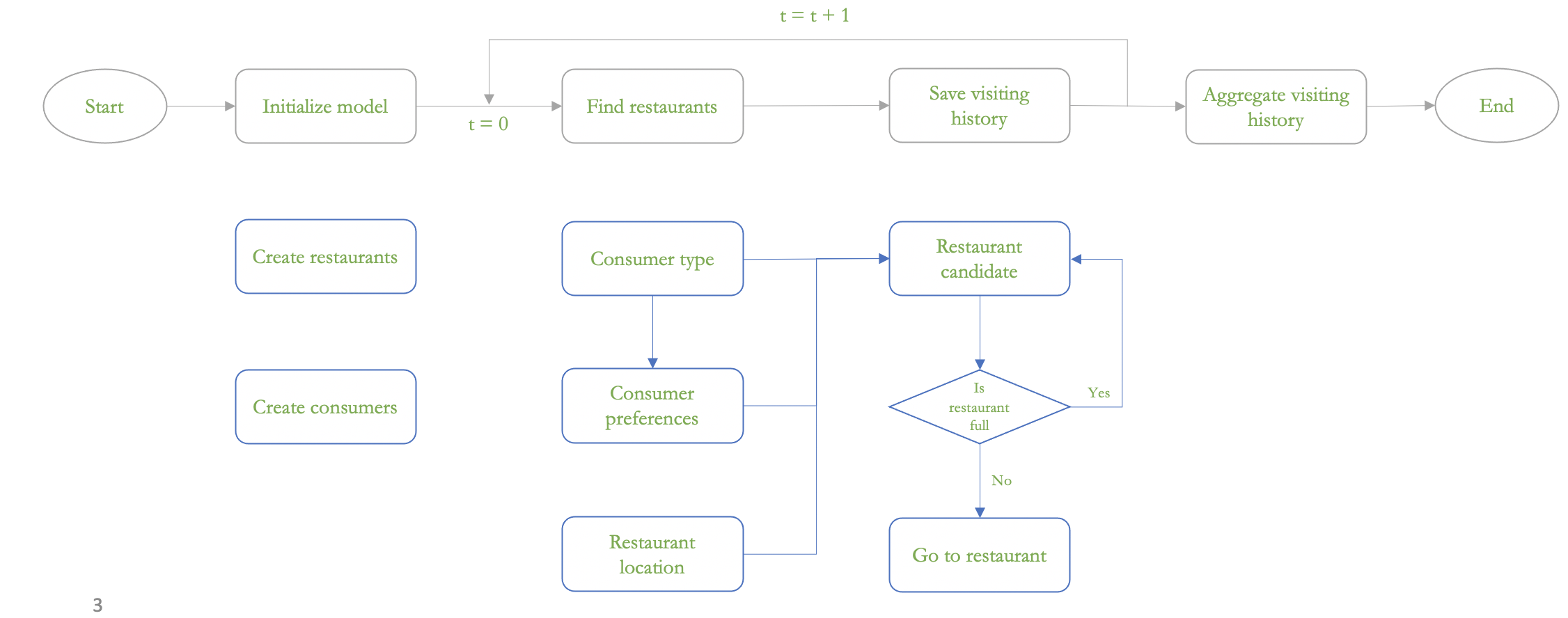
Switching gears slightly, we have another presentation that leverages text data, in this case Yelp reviews to help inform decision making within an agent-based model. This presentation with Boyu Wang is entitled "Do people care about others' opinions of places? Utilizing crowdsourced data and deep learning to model peoples’ review patterns."  We use a geospatial artificial intelligence (GeoAI) technique called aspect-based sentiment analysis to extract and categorize reviewers' opinion aspects on places within urban areas and then use this information to inform an agent-based model of peoples choices to which restaurants to go to.


Abstract  

People's opinions are one of the defining factors that turn spaces into meaningful places. While these opinions are subject to individual differences, they can also be influenced by the opinions from others. Online platforms such as Yelp allow users to publish their reviews on businesses. To understand reviewers' opinion formation processes and the emergent patterns of published opinions, we utilize geospatial artificial intelligence (GeoAI) techniques especially that of aspect-based sentiment analysis methods (a deep learning approach) on a geographically explicit Yelp dataset to extract and categorize reviewers' opinion aspects on places within urban areas. Such data is then used as a basis to inform an agent-based model, where reviewers' (i.e., agents') opinions are characterized by opinion dynamics. The parameters of these models are calibrated using extracted opinion aspects from the Yelp dataset. Such a method moves opinion dynamics models away from theoretical concepts to a more data-driven approach, with a specific emphasis being made on place. Focusing on 10 US metropolitan areas which are spread out across the country, we examine the calibrated influence coefficients for each opinion aspect category (e.g., location, experience, service), to compare reviewers' opinion formation processes across different categories. The results show the emergent patterns of reviewers' opinions and the influence of these opinions on others. As such this work demonstrates how using deep learning techniques on geospatial data can help advance our understanding of place and cities more generally.

Keywords: Agent-Based Modeling, Crowdsourcing, Deep Learning, GeoAI, Opinion Dynamics, Urban Analytics

Full Reference

Wang, B. and Crooks, A.T. (2023), Do People Care About Others' Opinions of Places? Utilizing Crowdsourced Data and Deep Learning to Model Peoples’ Review Patterns, The Association of American Geographers (AAG) Annual Meeting, 23rd –27th March, Denver, CO. (pdf)
Following with the agent-based modeling theme, our final presentation with Fuzhen Yin and Li Yin is entitled "How Information Propagation in Physical, Relational and Cyber Spaces Affects Covid-19 Vaccine Uptake: Evidence from Rural Areas." In this work we explore how people may or not be influenced by others (in physical, relational and cyber spaces) with respect to vaccination uptake.


Abstract 
With the advent of information and communication technologies, human dynamics studied in a purely physical space increasingly shift to a cyber and relational context. While researchers increasingly recognize the shift and call for attention to the multi-dimensionality of human dynamics (e.g., Splatial framework). Rarely have studies investigated how the information propagated in hybrid spaces affects people’s decision-making process, such as Covid-19 vaccine uptake. Meanwhile, compared to the urban population, the rural population faces greater digital barriers and has been further left out in human dynamics research. To fill this gap, our study investigates Covid-19 vaccine uptake in a rural county (i.e., Chautauqua) in New York State through agent-based modeling. We first generated a synthetic population to match the demographic characteristics of the census data. Then we created home, work, school, and social media networks to represent hybrid spaces. We defined the opinion dynamics of agents based on the social influence network theory. Next, we calibrated and validated our agent-based model based on real-world vaccine update records. Our research helps to elucidate the information propagation mechanism in hybrid spaces and clarify the decision-making process in the digital age. Furthermore, our method can also shed light on how to overcome data limitations for under-represented populations such as those who live in rural areas.

Keywords: Agent-based modeling, Covid-19, Vaccination, Opinion dynamics, Urban informatics, Rural geography

Full Reference 
Yin, F., Crooks, A.T. and Yin, L. (2023), How Information Propagation in Physical, Relational and Cyber Spaces Affects Covid-19 Vaccine Uptake: Evidence from Rural County, The Association of American Geographers (AAG) Annual Meeting, 23rd –27th March, Denver, CO. (pdf)

Tuesday, September 01, 2020

Beyond Words: Comparing Structure, Emoji Use, and Consistency Across Social Media Posts

Continuing our work on Emojis, at the forthcoming International Conference on Social Computing, Behavioral-Cultural Modeling and Prediction and Behavior Representation in Modeling and Simulation (or SBP-BRiMS for short) we (Melanie Swartz, Arie Croitoru and myself) have a paper entitled "Beyond Words: Comparing Structure, Emoji Use, and Consistency Across Social Media Posts." In the paper we introduce and demonstrate a language-agnostic methodology to characterize structures of content and emoji use within a document (in this case a tweet), measure consistency of structures across a set of documents, and cluster documents and users with similar patterns and behavior. Using a corpus of 44 million tweets collected in October and November 2018 related to the 2018 U.S. midterm elections based on keywords, hashtags, and user accounts associated with candidates or political parties we were able to gain insights into the unique or shared structures of communication styles and emoji use of over 3.3 million unique users and user roles such as journalists, bots and others. If this sounds of interest to you, below we provide the abstract to the paper, some tables and figures of the our findings along with the full reference and a link to the paper. Furthermore, if you are interested in extending this work to other areas, Melanie has made the code available at https://github.com/msemoji/.

Abstract
Social media content analysis often focuses on just the words used in documents or by users and often overlooks the structural components of document composition and linguistic style. We propose that document structure and emoji use are also important to consider as they are impacted by individual communication style preferences and social norms associated with user role and intent, topic domain, and dissemination platform. In this paper we introduce and demonstrate a novel methodology to conduct structural content analysis and measure user consistency of document structures and emoji use. Document structure is represented as the order of content types and number of features per document and emoji use is characterized by the attributes, position, order, and repetition of emojis within a document. With these structures we identified user signatures of behavior, clustered users based on consistency of structures utilized, and identified users with similar document structures and emoji use such as those associated with bots, news organizations, and other user types. This research compliments existing text mining and behavior modeling approaches by offering a language agnostic methodology with lower dimensionality than topic modeling, and focuses on three features often overlooked: document structure, emoji use, and consistency of behavior.
Keywords: Data Mining, Social Media, Emojis, User Behavior Modeling.
Emoji attributes

Most common content structures with emojis for non-retweets.

Clusters of users with similar behavior across two factors in non-retweets (left) and retweets (right) Colors indicate cluster assignments.

Full Reference: 
Swartz, M., Crooks, A.T. and Croitoru, A. (2020), Beyond Words: Comparing Structure, Emoji Use, and Consistency Across Social Media Posts, in Thomson, R., Bisgin, H., Dancy, C., Hyder, A. and Hussain, M. (eds), 2020 International Conference on Social Computing, Behavioral-Cultural Modeling & Prediction and Behavior Representation in Modeling and Simulation, Washington DC., pp 1-11. (pdf)


Wednesday, June 10, 2020

New Paper: A Thematic Similarity Network Approach for Analysis of Places Using VGI

Building upon our work on volunteered geographical information (VGI) and ambient geographic information (AGI) and how such data (e.g. social media) can be used to understand place, Xiaoyi Yuan, Andreas Züfle and myself have a new paper entitled: "A Thematic Similarity Network Approach for Analysis of Places Using Volunteered Geographic Information" in the ISPRS International Journal of Geo-Information.  In this paper we use textual data from crowdsourced reviews originating with TripAdvisor and geo-located Twitter data and leverage this unstructured geographical information to comprehend the complexity of places at scale. Specifically we explore the connectedness and relationships of places through thematic (i.e., topical) similarity networks using Manhattan, New York as a case study. If such work sounds of interest to you, below we provide the abstract to the paper in order for you to gain a greater understanding of work, along with some figures that show our workflow and how communities where connected, before presenting some of our results. Finally at the bottom of the post, the full reference and a link to the paper is provided.  For those interested in extending or utilizing this work. The python code for presented in our analysis is available at: https://bitbucket.org/xiaoyiyuan/network_vgi/

Abstract:
The research presented in this paper proposes a thematic network approach to explore rich relationships between places. We connect places in networks through their thematic similarities by applying topic modeling to the textual volunteered geographic information (VGI) pertaining to the places. The network approach enhances previous research involving place clustering using geo-textual information, which often simplifies relationships between places to be either in-cluster or out-of-cluster. To demonstrate our approach, we use as a case study in Manhattan (New York) that compares networks constructed from three different geo-textural data sources --TripAdvisor attraction reviews, TripAdvisor restaurant reviews, and Twitter data. The results showcase how the thematic similarity network approach enables us to conduct clustering analysis as well as node-to-node and node-to-cluster analysis, which is fruitful for understanding how places are connected through individuals’ experiences. Furthermore, by enriching the networks with geodemographic information as node attributes, we discovered that some low-income communities in Manhattan have distinctive restaurant cultures. Even though geolocated tweets are not always related to place they are posted from, our case study demonstrates that topic modeling is an efficient method to filter out the place-irrelevant tweets and therefore refining how of places can be studied.

Keywords: Geo-Textual Data, Volunteered Geographic Information, Crowdsourcing, Similarity Network Analysis, Topic Modeling

Work flow from data input to the construction of the thematic similarity network and analysis (i.e., community detection and unique nodes discovery).

A stylized network demonstrating the process of community detection from a fully-connected similarity network.


Network visualization of all communities from the thematic similarity networks with major communities highlighted. Only the major communities are shown on the map for the sake of clarity. Major communities in Network visualization and mapping for each network are colored the same and thus the legend applies for both.


Two examples of communities with boundary nodes and their respective topics.

Full Reference:
Yuan X., Crooks, A.T. and Züfle, A. (2020), A Thematic Similarity Network Approach for Analysis of Places Using Volunteered Geographic Information, ISPRS International Journal of Geo-Information,  9(6), 385, https://doi.org/10.3390/ijgi9060385. (pdf)

Thursday, January 08, 2015

Crowdsourcing Urban Form and Function

We have just had published a new paper entitled: "Crowdsourcing Urban Form and Function" in International Journal of Geographical Information Science which showcases some of our recent work with respect to cities and how new sources of information can be used to study urban morphology at a variety of spatial and temporal scales. Below is the abstract for the paper: 

"Urban form and function have been studied extensively in urban planning and geographic information science. However, gaining a greater understanding of how they merge to define the urban morphology remains a substantial scientific challenge. Towards this goal, this paper addresses the opportunities presented by the emergence of crowdsourced data to gain novel insights into form and function in urban spaces. We are focusing in particular on information harvested from social media and other open-source and volunteered datasets (e.g. trajectory and OpenStreetMap data). These data provide a first-hand account of form and function from the people who define urban space through their activities. This novel bottom-up approach to study these concepts complements traditional urban studies work to provide a new lens for studying urban activity. By synthesizing recent advancements in the analysis of open-source data we provide a new typology for characterizing the role of crowdsourcing in the study of urban morphology. We illustrate this new perspective by showing how social media, trajectory, and traffic data can be analyzed to capture the evolving nature of a city’s form and function. While these crowd contributions may be explicit or implicit in nature, they are giving rise to an emerging research agenda for monitoring, analyzing and modeling form and function for urban design and analysis."
This paper builds and extends considerably our prior work, with respect to crowdsourcing, volunteered and ambient geographic information. In the scope of this paper we use the term ‘urban form’ to refer to the aggregate of the physical shape of the city, its buildings, streets, and all other elements that make up the urban space. In essence, the geometry of the city. In contrast, we use the term ‘urban function’ to refer to the activities that are taking place within this space. To this end we contrast how crowdsourced data can related to more traditional sources of such information both explicitly and implicitly as shown in the table below. 

A typology of implicit and explicit form and function content

In addition, we also discuss in the paper how these new sources of data, which are often at finer resolutions than more authoritative data are allowing us to to customize the we we aggregate the data  at various geographical levels as shown below. Such aggregations can range from building footprints and addresses to street blocks (e.g. for density analysis), or street networks (e.g. for accessibility analysis). For large-scale urban analysis we can revert to the use of zonal geographies or grid systems.  
Aggregation methods for varied scales of built environment analysis

In the application section of the paper we highlight how we can extract implicit form and function from crowdsourced data. The image below for example, shows how we can take information from Twitter, and differentiate different neighborhoods over space and time.

Neighborhood map and topic modeling results showing the mixture of social functions in each area.

Finally in the paper, we outline an emerging research agenda related to the "persistent urban morphology concept" as shown below. Specifically how crowdsourcing is changing how we collect, analyze and model urban morphology. Moreover, how this new paradigm provides a new lens for studying the conceptualization of how cities operate, at much finer temporal, spatial, and social scales than we had been able to study so far.

The persistent urban morphology concept.

We hope you enjoy the paper.

Full Reference:  
Crooks, A.T., Pfoser, D., Jenkins, A., Croitoru, A., Stefanidis, A., Smith, D. A., Karagiorgou, S., Efentakis, A. and Lamprianidis, G. (2015), Crowdsourcing Urban Form and Function, International Journal of Geographical Information Science. DOI: 10.1080/13658816.2014.977905 (pdf)