Showing posts with label Newspapers. Show all posts

Thursday, February 06, 2025

From print to perspective: A mixed-method analysis of the convergence and divergence of COVID-19 topics in newspapers and interviews

In previous posts we have noted how one can explore urban issues through newspapers, while at the same time we have used social media to explore trends in vaccinations. In a recently published paper in PLOS Digital Health entitled "From print to perspective: A mixed-method analysis of the convergence and divergence of COVID-19 topics in newspapers and interviews" with Qingqing Chen, Adam Sullivan, Jennifer Surtees, Laurene Tumiel-Berhalter and myself, we thought we would explore how COVID-19 was reported in newspapers and how this varied from interviews. 

The rationale behind this was that the COVID-19 pandemic has led to diverse experiences influenced by public health measures like lockdowns and social distancing. To explore these dynamics, we introduce a novel ’big-thick’ data approach that integrates extensive U.S. newspaper data with detailed interviews. By employing natural language processing (NLP) and geoparsing techniques, we identify key topics related to the pandemic and vaccinations both in newspapers and personal narratives from interviews, and compare the (spatial) convergences and divergences between them. 

We found that both sources converge to highlight the profound impacts of the pandemic on daily life. However, newspapers provide a macro-level perspective, predominately covering policy, public health efforts and economics, while interviews reveal the nuanced impacts at the micro-level, focusing on personal experiences, emotion and concerns. An intriguing finding is the pronounced concern regarding the reliability of news information from interviews. By showcasing both convergences and divergences in identified topics, our study enhances the understanding of key issues that both disseminated to and resonate with the public, contributing to the development of more effective communication strategies for future public health crises.

If this sounds of interest, below you can read the abstract to the paper, see some of the figures which include our workflow and some of the results. At the bottom of the post you can see the full reference and a link to the actual paper. While at https://figshare.com/s/339b1c0d059c189dd6a4?file=44583661 you can find the code we used for our analysis. 

Abstract:

In the face of the unprecedented COVID-19 pandemic, various government-led initiatives and individual actions (e.g., lockdowns, social distancing, and masking) have resulted in diverse pandemic experiences. This study aims to explore these varied experiences to inform more proactive responses for future public health crises. Employing a novel “big-thick” data approach, we analyze and compare key pandemic-related topics that have been disseminated to the public through newspapers with those collected from the public via interviews. Specifically, we utilized 82,533 U.S. newspaper articles from January 2020 to December 2021 and supplemented this “big” dataset with “thick” data from interviews and focus groups for topic modeling. Identified key topics were contextualized, compared and visualized at different scales to reveal areas of convergence and divergence. We found seven key topics from the “big” newspaper dataset, providing a macro-level view that covers public health, policies and economics. Conversely, three divergent topics were derived from the “thick” interview data, offering a micro-level view that focuses more on individuals’ experiences, emotions and concerns. A notable finding is the public’s concern about the reliability of news information, suggesting the need for further investigation on the impacts of mass media in shaping the public’s perception and behavior. Overall, by exploring the convergence and divergence in identified topics, our study offers new insights into the complex impacts of the pandemic and enhances our understanding of key issues both disseminated to and resonating with the public, paving the way for further health communication and policy-making.
An overview of the research workflow.

The monthly distribution of collected articles in the United States from January 2020 to December 2021.

An example of identified entities labeled with predefined entity types.

The spatial distribution of newspaper articles by different scales.


The spatial distribution of identified newspaper topics across different regions in New York State.

Ordered rank of identified topics by percentage from interviews.

Full reference:
Chen, Q., Crooks, A.T., Sullivan, A.J., Surtees, J.A. and Tumiel-Berhalter, L. (2025). From Print to Perspective: A mixed-method analysis of the convergence and divergence of COVID-19 topics in newspapers and interviews, PLOS Digital Health. Available at https://doi.org/10.1371/journal.pdig.0000736. (pdf)

Wednesday, October 04, 2023

Leveraging newspapers to understand urban issues

In the past, this blog has explored several aspects of Detroit, such as how well its covered with Volunteered Street View Imagery or how through the use of agent-based models one can explore issues with urban shrinkage. Keeping up with the theme of shrinkage and Detroit but at the same time utilizing our growing interest in natural language processing (especially topic modeling) we (Na (Richard) Jiang, Hamdi Kavak, Wenjing Wang and myself) have a new paper entitled "Leveraging newspapers to understand urban issues: A longitudinal analysis of urban shrinkage in Detroit" published in Environment and Planning B

In the paper, we take 6794 English news articles published by national and local press organizations (e.g., Forbes, The New York Times, Newsweek, The Detroit News) between 1975 to 2021 using the keywords “Detroit”, “shrink” and “decline.” These keywords were selected based on the characteristics of the study area (i.e., Detroit) and the phenomenon of urban shrinkage. With these data we then use BERTopic to detect and classify all collected news articles into certain topics. We chose BERTopic because it captures the semantic relationship among words converting sentences and words to embedding and automatically generates the topic unlike other NLP topic modeling techniques (e.g., LDA). Our topic modeling results identify several insights with respect to Detroit's shrinkage. For example, we can detect the side effects of the 2007-2009 economic recession on Detroit's automobile industry, local employment status, and the housing market. If sounds of interest and you want to find out more, below we provide the abstract, some figures from the paper including the methodology workflow and an example of the resulting topics over time. Finally, at the bottom of the page you can see the full reference and s link to the paper itself.

Abstract 

Today we are awash with data, especially when it comes to studying cities from a diverse data ecosystem ranging from demographic to remotely sensed imagery and social media. This has led to the growth of urban analytics providing new ways to conduct quantitative research within cities. One area that has seen significant growth is using natural language processing techniques on text data from social media to explore various issues relating to urban morphology. However, we would argue that social media only provides limited insights when dealing with longer-term urban phenomena, such as the growth and shrinkage of cities. This relates to the fact that social media is a relatively recent phenomenon compared to longer-term urban problems that take decades to emerge. Concerning longer-term coverage, newspapers, which are increasingly becoming digitized, provide the possibility to overcome the limitations of social media and provide insights over a timeframe that social media does not. To demonstrate the utility of newspapers for urban analytics and to study longer-term urban issues, we utilize an advanced topic modeling technique (i.e., BERTopic) on a large number of newspaper articles from 1975 to 2021 to explore urban shrinkage in Detroit. Our topic modeling results reveal insights related to how Detroit shrinks. For example, side effects of 2007 to 2009 economic recessions on Detroit’s automobile industry, local employment status, and the housing market. 

Key Words: Natural Language Processing, Topic Modeling, Newspapers, Urban Shrinkage, Urban Analytics.


 Vacancy status change from 1970 to 2010 for city of Detroit and surrounding area.
Topic modeling work flow.
Topics over time (a) urban, (b) population, (c) shrinkage, (d) economy, (e) job, (f) house.

Full Reference:

Jiang, N., Crooks, A.T., Kavak, H. and Wang, W. (2023), Leveraging Newspapers to Understand Urban Issues: A Longitudinal Analysis of Urban Shrinkage in Detroit, Environment and Planning B. Available at https://doi.org/10.1177/23998083231204695. (pdf)

Thursday, July 14, 2022

Drone strikes and radicalization

In the past we had posted on models of radicalization, but such models were rather abstract.  Building on this previous work Brandon Shapiro and myself have a new paper entitled "Drone Strikes and Radicalization: An Exploration Utilizing Agent-Based Modeling and Data Applied to Pakistan" which has recently been published in Computational and Mathematical Organization Theory journal. In the paper we develop and present an agent-based model informed by theory and calibrated using empirical data to explore the relationship between kinetic actions (i.e., drone strikes) and terrorist attacks in Pakistan from 2004 through 2018. 

The data itself came from the Bureau of Investigative Journalism data as our source for Pakistan drone strikes (i.e., kinetic actions) and the National Consortium for the Study of Terrorism and Responses to Terrorism( START)  Global Terrorism Database (GTD) as our source for terrorist incidents. Rather than try to pinpoint and define the motivating factors which might influence somebody down a path toward radicalization, our model that incorporated a distributed lag model to characterize the inter-dependencies between drone strikes and terrorist attacks observed in Pakistan. Based on parametric and validation tests, the model simulates a terrorist attack curve which approximates the rate and magnitude observed in Pakistan from 2007 through 2018. 

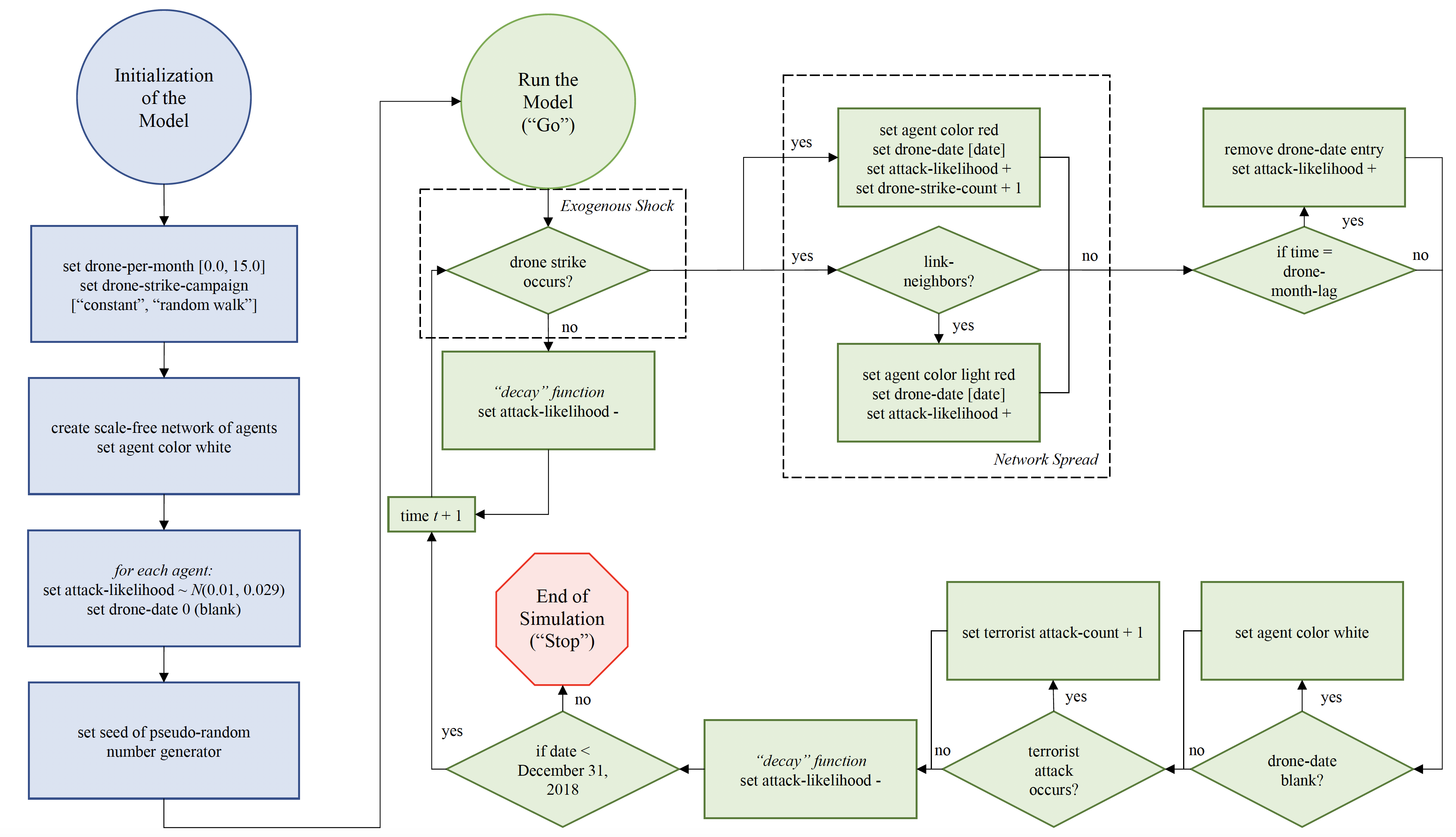
If this sounds of interest, below we provide the abstract to the paper, along with some images of model graphical user interface, the model logic and some of the results. The model itself was created in NetLogo and is available at: https://www.comses.net/codebase-release/30540ae3-486b-44e4-8ff0-785575433af0/  (along with the data and detailed ODD of the model). At the bottom of the page you can find the full citation and a link to the paper.

Abstract:

The employment of drone strikes has been ongoing and the public continues to debate their perceived benefits. A question that persists is whether drone strikes contribute to an increase in radicalization. This paper presents a data-driven approach to explore the relationship between drone strikes conducted in Pakistan and subsequent responses, often in the form of terrorist attacks carried out by those in the communities targeted by these particular counter terrorism measures. Our exploration and analysis of news reports which discussed drone strikes and radicalization suggest that government-sanctioned drone strikes in Pakistan appear to drive terrorist events with a distributed lag that can be determined analytically. We leverage news reports to inform and calibrate an agent-based model grounded in radicalization and opinion dynamics theory. This enabled us to simulate terrorist attacks that approximated the rate and magnitude observed in Pakistan from 2007 through 2018. We argue that this research effort advances the field of radicalization and lays the foundation for further work in the area of data-driven modeling and drone strikes.  
Keywords: Radicalization, Data-driven modeling, Drone strikes, Terrorism, Pakistan , Agent-based modeling.
Pakistan radicalization model’s graphical user interface. From left to right: model input param- eters, the agents’ social network and resulting model outputs

The agent-based model flow diagram.

Terrorist attacks simulated by Pakistan radicalization model qualitatively agree with real-world system.

Full Reference: 

Shapiro, B. and Crooks, A.T. (2022) Drone Strikes and Radicalization: An Exploration Utilizing Agent-Based Modeling and Data Applied to Pakistan, Computational and Mathematical Organization Theory. Available at https://doi.org/10.1007/s10588-022-09364-1. (pdf)


Tuesday, July 13, 2021

Kinetic Action and Radicalization

In the past we had posted on models of radicalization, but such models were rather abstract.  However in a recent paper entitled "Kinetic Action and Radicalization: A Case Study of Pakistan" which was presented at the  International Conference on Social Computing, Behavioral-Cultural Modeling and Prediction and Behavior Representation in Modeling and Simulation (or SBP-BRiMS for short) we take such work a step further. 

In the paper, Brandon Shapiro and myself develop and present a simple agent-based model informed by theory and calibrated using empirical data to explore the relationship between kinetic actions (i.e., drone strikes) and terrorist attacks in Pakistan from 2004 through 2018. The data itself came from the Bureau of Investigative Journalism data as our source for Pakistan drone strikes (i.e., kinetic actions) and the National Consortium for the Study of Terrorism and Responses to Terrorism( START)  Global Terrorism Database (GTD) as our source for terrorist incidents. 

Rather than try to pinpoint and define the motivating factors which might influence somebody down a path toward radicalization, our model that incorporated a distributed lag model to characterize the inter-dependencies between drone strikes and terrorist attacks observed in Pakistan. Based on parametric and validation tests, the model simulates a terrorist attack curve which approximates the rate and magnitude observed in Pakistan from 2007 through 2018. If this sounds of interest, below we provide the abstract to the paper, along with some images of model graphical user interface, the model logic and some of the results. The model itself was created in NetLogo and is available at: https://bit.ly/3qLJynv  (along with the data and detailed ODD of the model). At the bottom of the page you can find the full citation and a link to the paper.

Abstract. Drone strikes have been ongoing and there is a debate about their benefits. One major question is what is their role with respect to radicalization. This paper presents a data-driven approach to explore the relationship between drone strikes in Pakistan and subsequent responses, often in the form of terrorist attacks carried out by those in the communities targeted by these counter-terrorism measures. Our analysis of news reports which dis-cussed drone strikes and radicalization suggests that government-sanctioned drone strikes in Pakistan appear to drive terrorist events with a distributed lag that can be determined analytically. We then utilize these news reports to inform and calibrate an agent-based model which is ground-ed in radicalization and opinion dynamics theory. In doing so, we were able to simulate terrorist attacks that approximated the rate and magnitude ob-served in Pakistan from 2007 through 2018. We argue that this research effort advances the field of radicalization and lays the foundation for further work in the area of data-driven modeling and kinetic actions.

Keywords: Radicalization, Data-driven modeling, Drone strikes, Terrorism, Pakistan, Agent-based modeling.

Radicalization model’s graphical user interface.

The agent-based model flow diagram.

Terrorist attacks simulated by radicalization model qualitatively agree with real-world system.

Full Reference:
Shapiro, B. and Crooks, A.T. (2021), Kinetic Action and Radicalization: A Case Study of Pakistan, in Thomson, R., Hussain, M.N., Dancy, C.L. and Pyke, A. (eds), Proceedings of 2021 International Conference on Social Computing, Behavioral-Cultural Modeling & Prediction and Behavior Representation in Modeling and Simulation, Washington DC., pp 321-330. (pdf)

Friday, January 31, 2020

The Interplay Between the Media and the Public in Mass Shootings

Continuing our work on shootings we recently had a paper published in Criminology and Public Policy entitled: "Responses to Mass Shooting Events: The Interplay Between the Media and the Public." However, here we do not look at bots but instead explore the how the public responds to mass shooting events (e.g. Las Vegas, Sutherland Springs, Marshall County, Parkland, Santa Fe), by seeking additional information or exchanging opinions about them in media coverage (e.g. newspaper articles via LexisNexis) and through online sources of information (e.g. Google Trends, Wikipedia and Online Social Networks (i.e. Twitter)). 

Overall, our results show discernible patterns in both time and space in the public’s online information seeking activities after a mass shooting. In addition we find discernible online information seeking patterns in geographic space, with a focal area of interest in the state in which the shooting event occurs, surrounded by a region of reduced interest. This finding further suggests that online information seeking activities are driven, at least in part, by geographic proximity to mass shooting events.

If you wish to find out more about this research, below we provide the summary and policy implication to the paper along with some figures from our methodology (e.g., how we go about analyzing temporal and geographical trends) and some of the results. Finally at the bottom of the post we provide the full reference and a link to the paper.

Abstract:
Research Summary: Public mass shootings tend to capture the public’s attention and receive substantial coverage in both traditional media and online social networks (OSNs) and have become a salient topic in them. Motivated by this, the overarching objective of this paper is to advance our understanding of how the public responds to mass shooting events in such media outlets. Specifically, it aims to examine whether distinct information seeking patterns emerge over time and space, and whether associations between public mass shooting events emerge in online activities and discourse. Towards this objective, we study a sequence of five public mass shooting events that have occurred in the United States between October 2017 and May 2018 across three major dimensions: the public’s online information seeking activities, the media coverage, and the discourse that emerges in a prominent OSN. To capture these dimensions, respectively, data was collected and analyzed from Google Trends, LexisNexis, Wikipedia Page views, and Twitter. The results of our analysis suggest that distinct temporal patterns emerge in the public’s information seeking activities across different platforms, and that associations between an event and its preceding events emerge both in the media coverage and in OSNs.
Policy Implication: Studying the evolution of discourse in OSNs provides a valuable lens to observe how society’s views on public mass shooting events are formed and evolved over time and space. The ability to analyze such data allows tapping into the dynamics of reshaping and reframing public mass shooting events in the public sphere and enable it to be closely studied and modeled. A deeper understanding of this process, along with the emerging associations drawn between such events, can then provide policy and decision-makers with opportunities to better design policies and communicate the significance of their goals and objectives to the public.
A framework for the analysis of temporal and geographical trends .

The analysis processes of Twitter and LexisNexis data.

Geographic patterns in online search activity in Google Trends for the five events in our study.

Chronologically ordered Google Trends search activity (a, left) and Wikipedia page views (b, right). Each vertical solid black line marks the occurrence of one of four shooting events examined in the analysis (as indicated by the line label).

Mentions of prior events during the first approximately 1-month period following each event in each of the events studied. (a) Sutherland Springs, (b) Marshall County, (c) Parkland, (d) Santa Fe.

Full Reference:
Croitoru, A., Kien, S., Mahabir, R., Radzikowski, J., Crooks, A.T., Schuchard, R., Begay, T., Lee, A., Bettios, A. and Stefanidis, A. (2020), Responses to Mass Shooting Events: The Interplay Between the Media and the Public, Criminology and Public Policy, 19(2): 335–360. (pdf)

Thursday, November 08, 2018

Refugee Camps and Volunteered Geographical Information

Fig. 7. Stimulus-Awareness-Activism (SA2) framework
Previously we have posted on how one can use new sources of data  (e.g. Volunteered Geographical Information) to explore and understand the world around us, such as mass migration, urban form and function, or be used for the basis of a model. Continuing on with this research theme we recently had a paper published in PLoS ONE entitled: "News Coverage, Digital Activism, and Geographical Saliency: A Case Study of Refugee Camps and Volunteered Geographical Information."

In this paper we explore the relationship between news coverage (via Google news), search trends (via Google trends) and user edit contribution patterns in OpenStreetMap and  Wikipedia for refugee camps from around the world. Specifically we are interested in how news media coverage (and in particular digital media) impacts digital activism (i.e.  volunteers who contribute content to online communities). Based on our analysis we find that digital activism bursts tend to take place during periods of sustained build-up of public awareness deficit or surplus.

These findings are in line with two prominent mass communication theories: agenda setting and corrective action, and suggest the emergence of a novel Stimulus-Awareness-Activism (SA2) framework in today’s participatory digital age. We argue that this paper brings us one step closer to understanding the underlying mechanisms that drive digital activism in particular in the geospatial domain. Below you can read the abstract of the paper, see the refugee camps we studied and some of the results. At the bottom of the post we also provide the full reference and a link to the paper.

Abstract:
The last several decades have witnessed a shift in the way in which news is delivered and consumed by users. With the growth and advancements in mobile technologies, the Internet, and Web 2.0 technologies users are not only consumers of news, but also producers of online content. This has resulted in a novel and highly participatory cyber-physical news awareness ecosystem that fosters digital activism, in which volunteers contribute content to online communities. While studies have examined the various components of this news awareness ecosystem, little is still known about how news media coverage (and in particular digital media) impacts digital activism. In order to address this challenge and develop a greater understanding of it, this paper focuses on a specific form of digital activism, that of the production of digital geographical content through crowdsourcing efforts. Using refugee camps from around the world as a case study, we examine the relationship between news coverage (via Google news), search trends (via Google trends) and user edit contribution patterns in OpenStreetMap, a prominent geospatial data crowdsourcing platform. In addition, we compare and contrast these patterns with user edit patterns in Wikipedia, a well-known non-geospatial crowdsourcing platform. Using Google news and Google trends to derive a measure of thematic public awareness, our findings indicate that digital activism bursts tend to take place during periods of sustained build-up of public awareness deficit or surplus. These findings are in line with two prominent mass communication theories: agenda setting and corrective action, and suggest the emergence of a novel stimulus-awareness-activism framework in today’s participatory digital age. Moreover, these findings further complement existing research examining the motivational factors that drive users to contribute to online collaborative communities. This paper brings us one step closer to understanding the underlying mechanisms that drive digital activism in particular in the geospatial domain.

Figure 1. Study areas  (centroid location of camp).

Figure 5. OSM, Wikipedia, Google News, and Google Trends time series during a -/+4 months period around the strongest extremum point of each camp. The figures show that whereas OSM and Wikipedia entries tend to come in bursts, Google News and Trends display a more sustained type of activity.

Figure 6. The public awareness curve versus the cumulative OSM and Wikipedia edit activity during a -/+4 months period around the strongest extremum point of each camp. For camps such as Nyarugusu, OSM and Wikipedia bursts overlap with public awareness surplus. In other camps, such as Bidibidi, OSM edit activity bursts coincide with public awareness deficit.  

Full Reference: 
Mahabir, R., Croitoru, A., Crooks, A.T., Agouris, P. and Stefanidis, A. (2018), News Coverage, Digital Activism, and Geographical Saliency: A Case Study of Refugee Camps and Volunteered Geographical Information, PLoS ONE, 13(11): e0206825.   https://doi.org/10.1371/journal.pone.0206825 (pdf)