Thursday, July 14, 2022

Drone strikes and radicalization

In the past we had posted on models of radicalization, but such models were rather abstract.  Building on this previous work Brandon Shapiro and myself have a new paper entitled "Drone Strikes and Radicalization: An Exploration Utilizing Agent-Based Modeling and Data Applied to Pakistan" which has recently been published in Computational and Mathematical Organization Theory journal. In the paper we develop and present an agent-based model informed by theory and calibrated using empirical data to explore the relationship between kinetic actions (i.e., drone strikes) and terrorist attacks in Pakistan from 2004 through 2018. 

The data itself came from the Bureau of Investigative Journalism data as our source for Pakistan drone strikes (i.e., kinetic actions) and the National Consortium for the Study of Terrorism and Responses to Terrorism( START)  Global Terrorism Database (GTD) as our source for terrorist incidents. Rather than try to pinpoint and define the motivating factors which might influence somebody down a path toward radicalization, our model that incorporated a distributed lag model to characterize the inter-dependencies between drone strikes and terrorist attacks observed in Pakistan. Based on parametric and validation tests, the model simulates a terrorist attack curve which approximates the rate and magnitude observed in Pakistan from 2007 through 2018. 

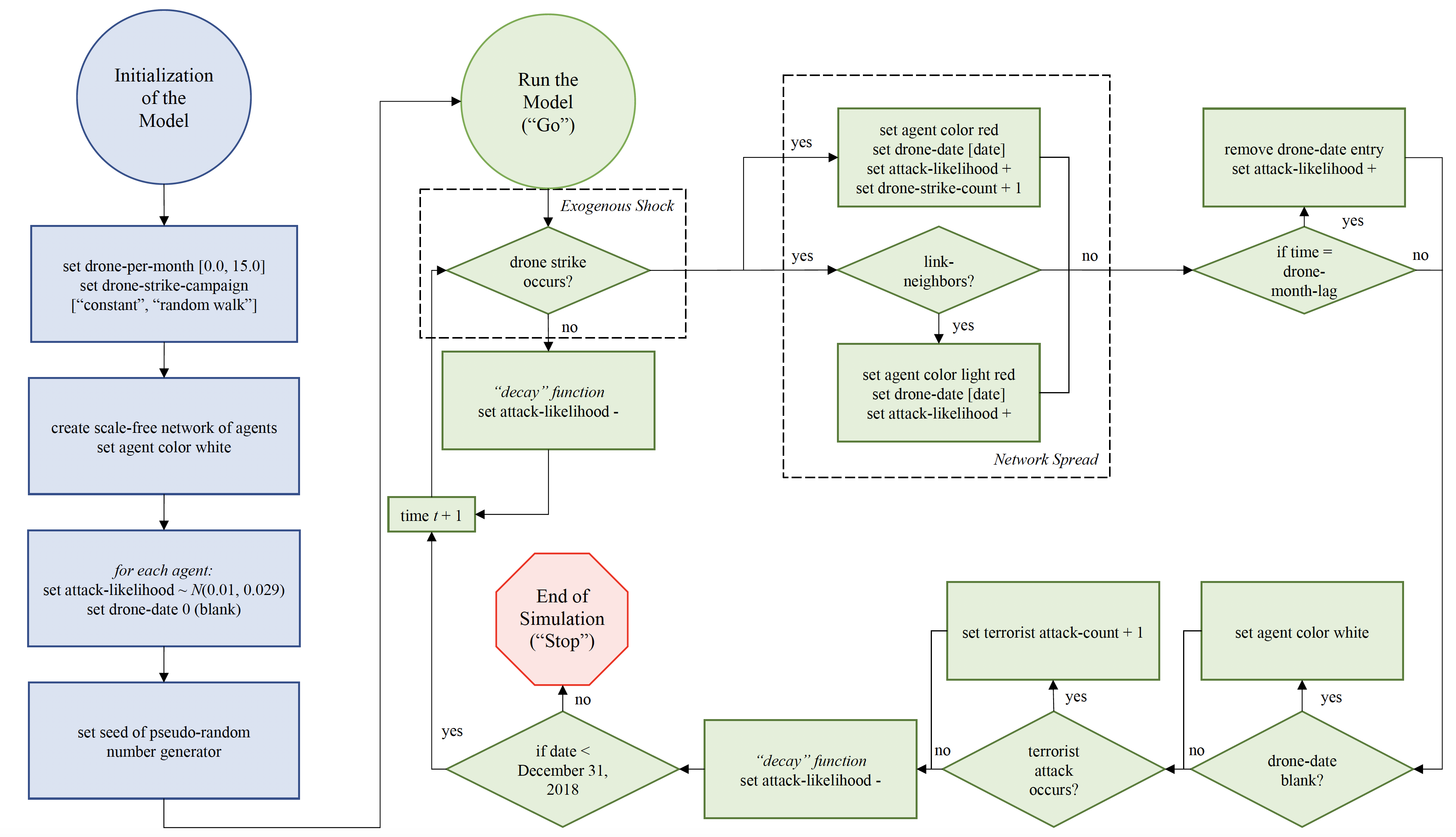
If this sounds of interest, below we provide the abstract to the paper, along with some images of model graphical user interface, the model logic and some of the results. The model itself was created in NetLogo and is available at: https://www.comses.net/codebase-release/30540ae3-486b-44e4-8ff0-785575433af0/  (along with the data and detailed ODD of the model). At the bottom of the page you can find the full citation and a link to the paper.

Abstract:

The employment of drone strikes has been ongoing and the public continues to debate their perceived benefits. A question that persists is whether drone strikes contribute to an increase in radicalization. This paper presents a data-driven approach to explore the relationship between drone strikes conducted in Pakistan and subsequent responses, often in the form of terrorist attacks carried out by those in the communities targeted by these particular counter terrorism measures. Our exploration and analysis of news reports which discussed drone strikes and radicalization suggest that government-sanctioned drone strikes in Pakistan appear to drive terrorist events with a distributed lag that can be determined analytically. We leverage news reports to inform and calibrate an agent-based model grounded in radicalization and opinion dynamics theory. This enabled us to simulate terrorist attacks that approximated the rate and magnitude observed in Pakistan from 2007 through 2018. We argue that this research effort advances the field of radicalization and lays the foundation for further work in the area of data-driven modeling and drone strikes.  
Keywords: Radicalization, Data-driven modeling, Drone strikes, Terrorism, Pakistan , Agent-based modeling.
Pakistan radicalization model’s graphical user interface. From left to right: model input param- eters, the agents’ social network and resulting model outputs

The agent-based model flow diagram.

Terrorist attacks simulated by Pakistan radicalization model qualitatively agree with real-world system.

Full Reference: 

Shapiro, B. and Crooks, A.T. (2022) Drone Strikes and Radicalization: An Exploration Utilizing Agent-Based Modeling and Data Applied to Pakistan, Computational and Mathematical Organization Theory. Available at https://doi.org/10.1007/s10588-022-09364-1. (pdf)


Thursday, July 07, 2022

Call for papers: GeoSim 2022

The GeoSim 2022 workshop focuses on all aspects of geospatial simulation as a paradigm to understand, model, and predict spatial phenomena and aid decision making. New simulation methodologies and frameworks, not necessarily coming from the SIGSPATIAL community, are encouraged to participate. Also, this workshop is of interest to everyone who works with spatial data. The simulation methods that will be presented and discussed in the workshop should find a wide application across the community by producing benchmark datasets that can be parameterized and scaled. Simulated data sets will be made available to the community via the website.

The workshop seeks high-quality full (8-10 pages) and short (up to 4 pages) papers that will be peer-reviewed. Once accepted, at least one author is required to register for the workshop and the ACM SIGSPATIAL conference, as well as attend the workshop to present the accepted work which will then appear in the ACM Digital Library.

We solicit novel and previously unpublished research on all topics related to geospatial simulation including, but not limited to:
  • Disease Spread Simulation
  • Urban Simulation
  • Agent Based Models for Spatial Simulation
  • Multi-Agent Based Spatial Simulation
  • Big Spatial Data Simulation
  • Spatial Data/Trajectory Generators
  • Environmental Simulation
  • GIS using Spatial Simulation
  • Modeling and Simulation of COVID-19
  • Interactive Spatial Simulation
  • Spatial Simulation Parallelization and Distribution
  • Geo-Social Simulation and Data Generators
  • Social Unrest and Riot Prediction using Simulation
  • Spatial Analysis based on Simulation
  • Behavioral Simulation
  • Verifying, and Validating Spatial Simulation
  • Applications for Spatial Simulation


Workshop information

Submission deadline: September 01, 2022
Author Notification: September 27, 2022
Workshop date: November 01, 2022


Workshop website: http://www.geosim.org
Submission site: https://easychair.org/conferences/?conf=geosim2022


Wednesday, June 01, 2022

Sample Models from Spatial Simulation (Spring 2022)

Continuing the tradition of making a post of some of the models developed by students in my classes as part of their end of semester projects, this spring I taught a graduate class entitled “Spatial Simulation” (the course description is below for these who are interested). 

For many, this is their first exposure to agent-based and cellular automata (CA) modeling. As part of the class the students were expected to complete an end of semester project, in this case, develop an agent-based or CA model that explores some aspect of the course themes.   The movie below shows a selection of these projects which ranged from how fish respond to turbulence to that of land use change over years and several other  topics in-between.

Coarse Description:

This graduate course will introduce students in the geographical and environmental sciences to the use of spatial simulation methods (e.g., cellular automata, agent-based modeling) to explore complex geographical phenomena from the bottom up. For example, how the micro-movement of pedestrians lead to the emergence of crowds or how individuals buying and selling houses lead to property markets forming. We will cover geographical applications in areas such as agriculture, biodiversity, interactions between human populations and nonhuman species and cities. Emphasis will be placed on the notion that geographical systems are constantly changing at various spatiotemporal scales and how through spatial simulation we can gain an understanding of the processes that lead to patterns that we can observe through data. The course will combine taught classes, literature reviews and discussions with hands-on spatial simulation modeling. The format of the class will consist of both lecture and discussion, with substantial emphasis on student participation.


Tuesday, May 10, 2022

Analyzing the vaccination debate in social media data Pre- and Post-COVID-19 pandemic

In the past we have written about how vaccination is discussed on social media but such studies were often just focused on short study periods (i.e. a month). However, with the current COVID-19 pandemic we thought we would revisit the vaccination  debate and see if it has changed. So in a new paper with Qingqing Chen entitled "Analyzing the vaccination debate in social media data Pre- and Post-COVID-19 pandemic," we did just that. We explored approximately 11.7 million tweets posted between January 2015 to July 2021 and measured and mapped vaccine sentiments (Pro-vaccine, Anti-vaccine, and Neutral) across the US. Not to ruin the surprise of what we found but also to encourage you to read the paper we will not write about the results here. Only show the abstract of the paper, a few of the figures and a link to the paper itself.

Abstract

The COVID-19 virus has caused and continues to cause unprecedented impacts on the life trajectories of millions of people globally. Recently, to combat the transmission of the virus, vaccination campaigns around the world have become prevalent. However, while many see such campaigns as positive (e.g., protecting lives), others see them as negative (e.g., the side effects that are not fully understood scientifically), resulting in diverse sentiments towards vaccination campaigns. In addition, the diverse sentiments have seldom been systematically quantified let alone their dynamic changes over space and time. To shed light on this issue, we propose an approach to analyze vaccine sentiments in space and time by using supervised machine learning combined with word embedding techniques. Taking the United States as a test case, we utilize a Twitter dataset (approximately 11.7 million tweets) from January 2015 to July 2021 and measure and map vaccine sentiments (Pro-vaccine, Anti-vaccine, and Neutral) across the nation. In doing so, we can capture the heterogeneous public opinions within social media discussions regarding vaccination among states. Results show how positive sentiment in social media has a strong correlation with the actual vaccinated population. Furthermore, we introduce a simple ratio between Anti and Pro-vaccine as a proxy to quantify vaccine hesitancy and show how our results align with other traditional survey approaches. The proposed approach illustrates the potential to monitor the dynamics of vaccine opinion distribution online, which we hope, can be helpful to explain vaccination rates for the ongoing COVID-19 pandemic.

Keywords: COVID-19, Pandemic, Vaccination Sentiment Analysis, Time and Space, Social Media, United States.

Overview of our research pipeline.

Comparison between Twitter data and Google Trends. (a) Distribution of keywords search and tweets over time; (b) Correlation between Google Trends and Twitter data of keywords search; (c) Important news or announcements catched on Twitter activity (Note: period is the shaded area in (a)).

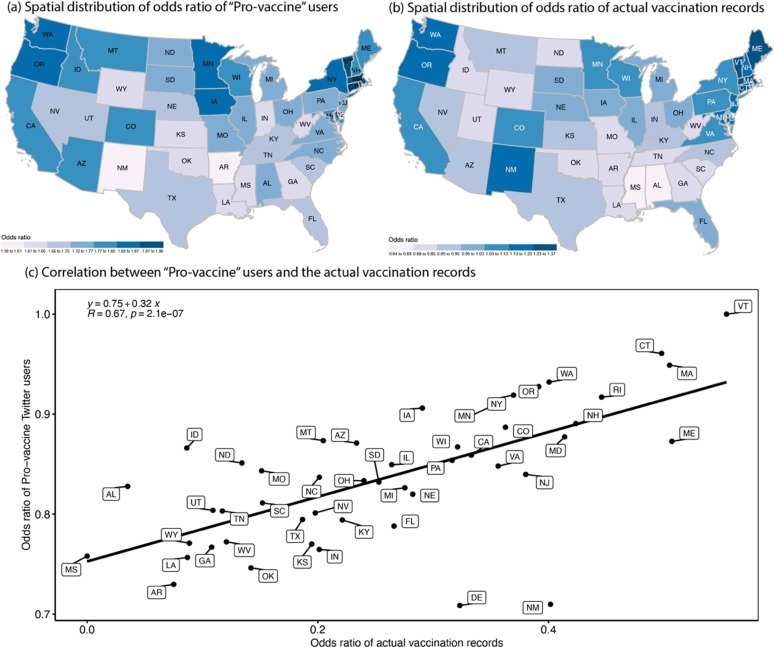
Correlation between Pro-vaccine users and actual vaccination records (a) Spatial distribution of odds ratio of Pro-vaccine users; (b) Spatial distribution of odds ratio of actual vaccination records; (c) Correlation between the Pro-vaccine users and the actual vaccination records.

Full Reference: 

Chen, Q. and Crooks, A.T. (2022), Analyzing the Vaccination Debate in Social Media Data Pre- and Post-COVID-19 Pandemic, International Journal of Applied Earth Observation and Geoinformation, 110: 102783.  Available at https://doi.org/10.1016/j.jag.2022.102783 (pdf)


Friday, April 22, 2022

Segregation models and urban studies

A couple of weeks ago I got to watch a talk by Itzhak Benenson and Erez Hatna who discussed the Schelling model and its impact on urban studies and thought it was worth sharing here. This talk was part of the Urban Models Seminar Series from the TU-Delft Urbanism group. The group has a great collection of other talks on their YouTube channel which are worth checking out.