Thursday, February 09, 2023

Comparison between Online Social Media Discussions and Vaccination Rates

Continuing our work on social media and vaccinationsQingqing Chen, Arie Croitoru, and myself have a new paper entitled "A comparison between online social media discussions and vaccination rates: A tale of four vaccines" published in DIGITAL HEALTH. In the paper we explore online debates among four prominent vaccines (i.e., COVID-19, Influenza, MMR, and HPV) as captured on Twitter in the United States (US) from 2015 to 2021.

By using machine learning models (e.g., Naive Bayes, support vector machine (SVM), logistic regression, and extreme gradient boosting (XGBoost)) on over  11.7 million Twitter messages sent by approximately 2.6 million distinct users we found that while the COVID-19, it has come to dominate the vaccination discussion, there was an apparent discrepancy between the online debates and the actual vaccination rates in the US. 

If this sounds of interest and you wish to find out more, below we provide the abstract to to the paper, some figures which captures our workflow and a sample of the results such as a comparison between different vaccine discussions on Twitter and the actual vaccination rate. Finally at the bottom of the page you can find the full reference and a link to the paper.

Abstract

The recent COVID-19 pandemic has brought the debate around vaccinations to the forefront of public discussion. In this discussion, various social media platforms have a key role. While this has long been recognized, the way by which the public assigns attention to such topics remains largely unknown. Furthermore, the question of whether there is a discrepancy between people's opinions as expressed online and their actual decision to vaccinate remains open. To shed light on this issue, in this paper we examine the dynamics of online debates among four prominent vaccines (i.e., COVID-19, Influenza, MMR, and HPV) through the lens of public attention as captured on Twitter in the United States from 2015 to 2021. We then compare this to actual vaccination rates from governmental reports, which we argue serve as a proxy for real-world vaccination behaviors. Our results demonstrate that since the outbreak of COVID-19, it has come to dominate the vaccination discussion, which has led to a redistribution of attention from the other three vaccination themes. The results also show an apparent discrepancy between the online debates and the actual vaccination rates. These findings are in line with existing theories, that of agenda-setting and zero-sum theory. Furthermore, our approach could be extended to assess the public's attention toward other health-related issues, and provide a basis for quantifying the effectiveness of health promotion policies.

Keywords:  COVID-19, Influenza, MMR, HPV, Social media, Vaccination.


The workflow for comparing between online social media discussion and vaccination rates.

The quarterly distribution of percentage of users by different vaccine discussion from 2015 to 2021.

 The comparison between different vaccine discussions on Twitter and growth rate of the actual vaccination rate collected from the CDC (a) COVID-19; (b) Influenza; (c) HPV; (d) MMR.

The changes of emotion over time for different vaccines.

Full reference: 

Chen Q, Croitoru A. and Crooks A.T (2023), A Comparison between Online Social Media Discussions and Vaccination Rates: A tale of four vaccines. DIGITAL HEALTH: 9. doi:10.1177/20552076231155682. (pdf)

Thursday, January 26, 2023

Repast4Py

In the past we have blogged about how we are using the Python agent-based modeling framework Mesa. But we would be remiss if we did not also mention other Python toolkits. One of which is Repast4Py from the people we created Repast suite. To quote from their user guide website:

To find out more about Repast4Py I highly recommend readers to look at the following publications or their webpage: https://repast.github.io/repast4py.site/.

References:


Thursday, December 08, 2022

Simulating Geographical Systems using CA and ABMs

 
In the chapter we discuss how thinking and studying of geographical systems like cities has changed over time from top down aggregate analysis to more bottom up approaches which captures the complex nature of such systems. We then discuss how we can model such systems from a cellular automata and agent-based perspectives. and how these styles of models have evolved and how they can be used to model future systems. If this sounds of interest below we provide the abstract to the chapter, some of the figures that accompany it and at the  bottom of the page we provide the full reference to the paper along with a link to the chapter itself.
"Abstract: How we view and understand the processes driving and shaping geographical systems is constantly evolving. This is due to the appearance of new rich data sources, increased computing power and storage, and the development of individual-level approaches. This allows us to explore geographical systems (from the bottom up) at scales not possible in the past. In this chapter, we examine the utility of two of the most commonly used individual-level modelling approaches, cellular automata and agent-based modelling. We outline their key differences and how these models are being used to further our understanding of geographical systems through simulation. We conclude with a discussion about the challenges that both approaches need to meet to continue developing into the future.
Keywords: Cellular automata; Agent-based models; Geographical systems; Machine learning
 

A SLEUTH like model stylized on Santa Fe, New Mexico denoting how land use charges over time from undeveloped (grey) to urban (red).

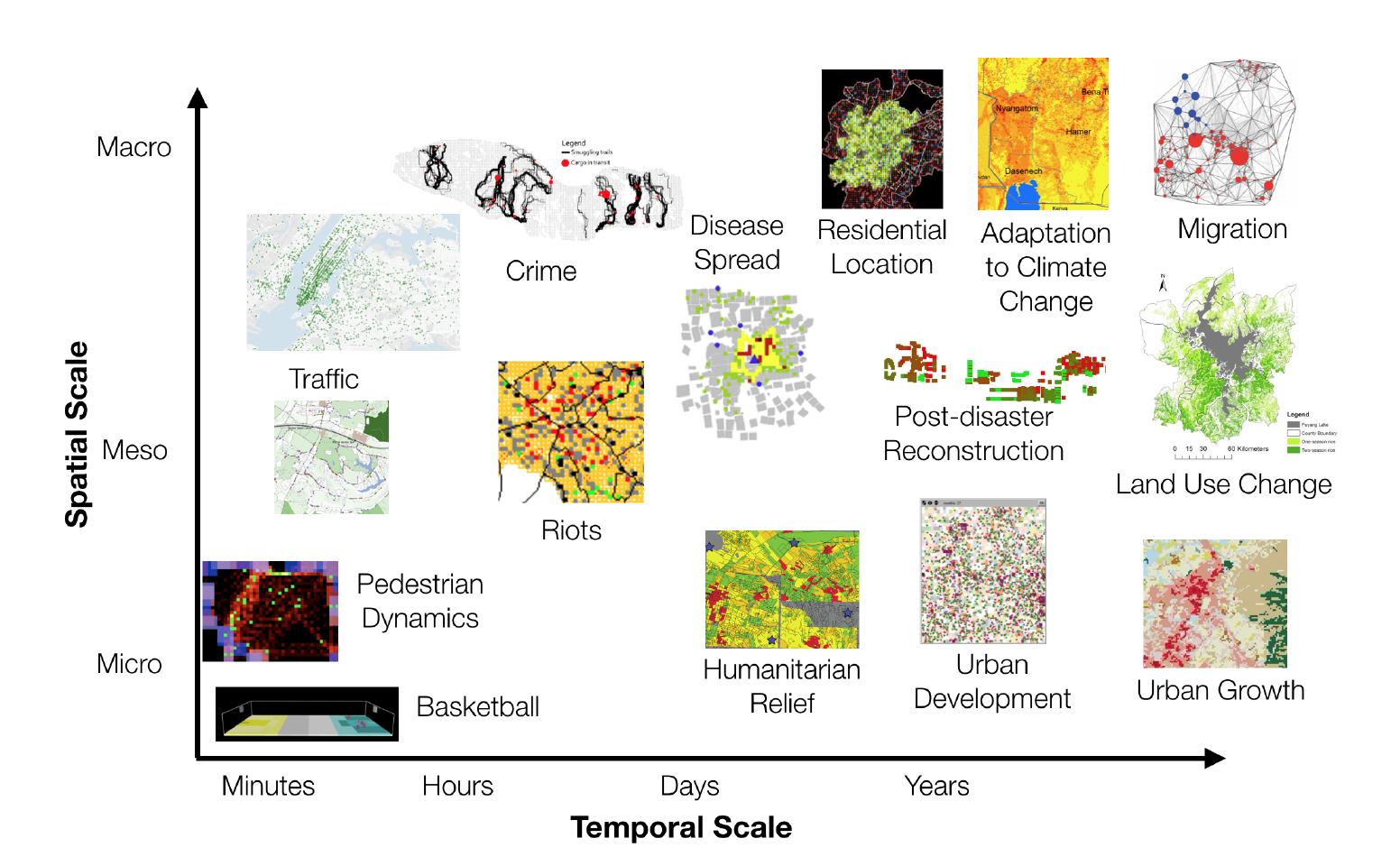
Example applications of agent-based models at different spatial and temporal scales

Full reference:

Heppenstall, A., Crooks, A.T., Manley, E. and Malleson, N. (2022) Simulating Geographical Systems using Cellular Automata and Agent-based Models, in Rey S. and Franklin, R. (eds.), Handbook of Spatial Analysis in the Social Sciences, Edward Elgar Publishing, Cheltenham, UK, pp. 142-157. (pdf)

Friday, November 11, 2022

Announcing MASON 21, Geomason 1.7 & Distributed MASON 1

Many visitors and readers to this site know that for a long time I have been involved with and developing agent-based models utilizing MASON. To this end, the other day Sean Luke posted a message to the MASON list-serve regarding new releases of MASON, GeoMASON  and the first release of Distributed MASON which is part of our NSF CI-EN: Enhancement of a Large-scale Multiagent Simulation Tool project

To quote from the email:

"MASON is a high performance open-source modeling toolkit in pure Java, designed to be fast, highly hackable and modifiable, and to guarantee repeatable results, among many other capabilities. MASON comes with extensive visualization capabilities and regularly runs on everything from laptops to back-end supercomputers".

"Distributed MASON is an open-source, massively distributed version of MASON meant for server/farm and cloud computing deployment using a combination of MPI and RMI. It runs MASON over a large number of collective machines. "

"GeoMASON is an open source set of extensions to MASON which add GIS capabilities, including reading and writing standard formats, embodying agents in GIS environments, and visualization."

"Distributed GeoMASON is an open source set of extensions to GeoMASON to enable it to run over Distributed MASON in both server/farm and cloud computing environments."

For those interested in GIS and agent-based models, we have added many more application examples (a sample of which is shown below), along with fixing a number of bugs, and adding new code for compatibility with Distributed MASON. For more details check out the MASON webpage: http://cs.gmu.edu/~eclab/projects/mason/.

Examples of some of the GeoMason Models

If you have questions regarding MASON, GeoMason, or their distributed versions, join the MASON mailing list and ask


Tuesday, November 01, 2022

Mesa-Geo: ABM and GIS in Python (A Update)

A couple of months ago we had a post about Mesa-Geo but only a short one. Now we want to go into more detail as we (Boyu Wang, Vincent Hess and myself) just presented a paper about it at the 5th ACM SIGSPATIAL International Workshop on Geospatial Simulation (GeoSim 2022). The paper itself was entitled "Mesa-Geo: A GIS Extension for the Mesa Agent-Based Modeling Framework in Python" in which we discuss in detail the need for a python library for creating geographically explicit agents (or GeoAgents) and introduce its architecture. 

In the paper we detail how we have designed Mesa-Geo to handle spatial data (both in terms of raster and vector via GeoSpace), how we have enabled visualization of geographical data and such models along with creating features to export geographical data from the simulations (using Rasterio and GeoPandas). To support this discussion we also provide some explicit examples on how the pieces fit together  range from rainfall flowing over a digital terrain model (DEM) to Schelling types of models using points and polygons as agents, to that of agents using road networks to navigate over an area. Boyu has also put together more details about the examples at: https://mesa-geo.readthedocs.io/en/latest/examples/overview.html (which includes movies of them running).  The actual code for the models and Mesa-Geo can be found at https://github.com/projectmesa/mesa-geo. Just to give you a sense of the paper and what Mesa-Geo can do, below we provide the abstract to the paper, some figures showing the architecture, along with some example applications. While at the bottom of the post you can see the full reference and a link to the paper itself.  


Abstract: Mesa is an open-source agent-based modeling (ABM) framework implemented in the Python programming language, allowing users to build and visualize agent-based models. It has been used in a diverse range of application areas over the years ranging from biology to workforce dynamics. However, there has been no direct support for integrating geographical data from geographical information systems (GIS) into models created with Mesa. Users have had to rely on their own implementations to meet such needs. In this paper we present Mesa-Geo, a GIS extension for Mesa, which allows users to import, manipulate, visualize and export geographical data for ABM. We introduce the main components and functionalities of Mesa-Geo, followed by example applications utilizing geographical data which demonstrates Mesa-Geo's core functionalities and features common to agent-based models. Finally, we conclude with a discussion and outlook on future directions for Mesa-Geo.

Class diagram of the Agent, GeoAgent, and Cell classes
Component diagram of GeoSpace and its related classes
Example applications using Mesa and Mesa-Geo: (a) Rainfall model, (b) Population model, (c) GeoSchelling (polygons) model, (d) GeoSchelling (points \& polygons) model, and (e) Agents and networks model.


 If you have any thoughts or comments about Mesa-Geo please let us know.

Full reference:

Wang, B., Hess, V. and Crooks A.T. (2022), Mesa-Geo: A GIS Extension for the Mesa Agent-Based Modeling Framework in Python, Proceedings of the 5th ACM SIGSPATIAL International Workshop on Geospatial Simulation (GeoSim 2022), Seattle, WA. pp 1-10. (PDF)