
Monday, December 11, 2006
New Template
We have just moved over to the new blogger template which makes it possible to search for themes within the blog. Just click on any word next to the word labels for any post and get all posts on a similar theme.

Repast Model of the Week: Fads Model
 The Fads Model from Tom Carter is a well commented model utilizing some of Repasts core functions including OpenSequenceGraph, OpenHistogram (histogram), reading in a .pgm for the space, and uses Object2DTorus for the underlying agent grid. The model writes information out using the DataRecorder object
Similar to other Repast Models, the typical way to code a simulation is to divide up the creation of the simulation into three methods - buildModel(), buildDisplay(), buildSchedule(). This division is not strictly necessary, but it does make the creation conceptually clearer and this is what the Fad model does
The buildModel() method is responsible for creating those parts of the simulation that represent what is being modeled. Consequently, the agents and their environment are typically created here together with any optional data collection objects. Of course, this method may call other methods to help build the model.
There are also a few other Repast models available from Tom Carters website: NinaNet, NinaNet2, and WealthModel.
Further information
The original source code of the fads model model can be found:
http://csustan.csustan.edu/~tom/SFI-CSSS/2005/FadsModel/
The model can either be run as a .jnlp (ie using Java web start therefore works on any OS) from:
The model can either be run as a .jnlp (ie using Java web start therefore works on any OS) from:
Or run as an executable by clicking here (Sorry it will only work in Windows). For instructions on how to run a Repast model see the Repast website.
Friday, November 24, 2006
Developing a Prototype Agent-Based Pedestrian Evacuation Model to Explore the Evacuation of King’s Cross St Pancras Underground Station
 Here is a working paper, which is a modification of the one Christian presented at Agent 2006, entitled “Developing a Prototype Agent-Based Pedestrian Evacuation Model to Explore the Evacuation of King’s Cross St Pancras Underground Station.”
London’s King’s Cross St. Pancras underground station has been the unfortunate location of two major incidents within the last twenty years. A fire in November 1987 and the terrorist bombing in July 2005 both resulted in the loss of lives, and the injury of many people. The implementation of measures to mitigate or neutralise the effect of all possible future incidents at this site is unrealistic. The adoption of preparedness measures is crucial for the emergency services to limit the loss of life and property, and to improve the response phase of an incident. King’s Cross St. Pancras underground station is currently being redeveloped, partly to mitigate the remaining few operational and safety issues identified after the 1987 fire, and also to allow for a predicted increase in passenger use. Despite these modifications and improvements, both the surrounding built environment and the station will necessarily remain complex structures. The local emergency services have several duties placed upon themselves in the event of a major incident at this site, and a computer based model capable of examining the effects of different incident assumptions or contingencies has been identified as potentially beneficial to the local National Health Service resilience planning department. The specific aim of this paper is to provide the reader with an overview of this research project. To begin, the aims and deliverables are identified. In light of these, principles of pedestrian evacuation modelling are presented, highlighting a shift in approaches: from aggregate movement, to individual-level movement and behavioural models. The feasibility of using a proprietary pedestrian evacuation model to achieve the research goal is discussed. This is followed by an agenda for developing an agent-based pedestrian evacuation model using the Repast toolkit. This paper concludes with progress of the prototype model to date.
Keywords: Pedestrian evacuation modelling, Agent-Based Modelling, Repast toolkit, London’s King’s Cross St. Pancras underground station.
The paper is available for download at the CASA website under working papers. Alternatively click here.
Friday, November 17, 2006
Social Science Applications utilising GIS at the CASA
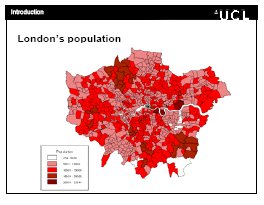 The other day I was invited by the Scottish Executive Geographical Information Service (SEGIS) to give a keynote speech at their meeting entitled “Innovative Methods: The Role of GIS in Government Social Research.” The aim of the meeting was to demonstrate to social researchers within the Scottish Executive the opportunities that exist with GIS.
The talk I presented was based on a number of GIS research applications from CASA and was entitled "Social Science Applications utilising GIS at the Centre for Advanced Spatial Analysis"

I would like to thank those at CASA that gave me some material for the talk.
Wednesday, November 01, 2006
Switching Servers
We just had to switch servers, We have tried to update all the links but if any of the links don’t work please let us know and we sort it out.